

Introduction
Seven years ago, Victoria’s Secret cancelled its fashion show and the obituaries wrote themselves. Ratings had collapsed to an all-time low, critics called the brand’s beauty standards a relic, and a new generation of challengers was taking its customers with a simple promise: inclusivity the old guard refused to offer.
The runway that once commanded 12 million television viewers had become a symbol of everything marketing was supposed to have outgrown. The Victoria’s Secret Fashion Show 2026, which lit up Sony Pictures Studios in Culver City, California on October 18, is the answer to every one of those obituaries — and it is one of the most instructive brand revival marketing campaigns of the decade.
Here is what happened on that stage. Kylie Jenner made her Victoria’s Secret runway debut wearing the $50 million Fantasy Bra — the most expensive in the garment’s 30-year history and the first to appear on a runway since 2018. Crafted by Jacob Arabo of Jacob & Co. from 4,410 natural diamonds around a 75.54-carat Fancy Vivid yellow diamond, the piece took more than 1,000 hours of work by 15 craftspeople. Her boyfriend Timothée Chalamet and her mother Kris Jenner watched from the front row, and a nine-second clip of Chalamet’s reaction went viral within hours.
Around that centerpiece, the brand assembled its heaviest artillery: Adriana Lima walking her record 21st show, Alessandra Ambrosio her 20th, Candice Swanepoel her 14th, an all-female performer lineup of Megan Moroney, Tate McRae, KATSEYE and Megan Thee Stallion, a first-ever cinema screening at ten AMC theaters, and a post-show TikTok Live. The show even moved from Wednesday to Sunday — because, as the brand’s chief marketing and customer officer Elizabeth Preis put it, Sunday is “an easy day for people to get together.”
And the timing is no accident. Victoria’s Secret is in the middle of a genuine commercial turnaround: Q2 2026 net sales rose 10% to $1.6 billion, comparable sales climbed 9%, the fifth consecutive quarter of sales growth and the fourth of customer growth, with what Preis calls “outsize growth among younger customers.”
The 2024 comeback show generated 66 million social media engagements and 414 million video views from influencer content alone. The Victoria’s Secret Fashion Show 2026 is not a fashion event with marketing attached — it is a marketing event wearing a fashion show’s clothes, and every brand trying to stage a comeback should be taking notes.
Here are nine brand revival marketing lessons from the Victoria’s Secret Fashion Show 2026 that any business can steal.
Lesson 1: Revive Your Icon Instead of Inventing Novelty
The single smartest decision in the Victoria’s Secret Fashion Show 2026 was not a new idea at all. It was an old one, brought back at exactly the right moment: the Fantasy Bra. The bejeweled showpiece had not appeared on the runway since 2018, and its return was, in the words of executive creative director Adam Selman, “a direct response to fan demand.” The brand did not need to invent a spectacle. It owned one already — it just had to remember it had it.
This is the first brand revival marketing lesson of the Victoria’s Secret Fashion Show 2026: your most powerful comeback asset is probably sitting in your own archive. Every legacy brand has an icon — a product, a ritual, a visual, a catchphrase — that the audience still remembers fondly. The Fantasy Bra had thirty years of cultural equity baked in, from Claudia Schiffer’s 1996 original through Gisele Bündchen’s record-setting 2000 version. No new concept could have carried that weight, because no new concept could have carried the nostalgia. The revival worked because the audience had been asking for it; Selman said so on the record.
Audit your own history before you invent your future. Ask your customers which discontinued product, retired campaign, or forgotten ritual they still talk about. The answers are usually surprising — and they come with pre-built demand, which is the one thing money cannot buy. Product revivals work the same way we have seen in launch marketing: our Doritos Lemon Pepper product launch marketing lessons showed how a heritage flavor idea can generate search demand before a product even exists. The Victoria’s Secret Fashion Show 2026 applied the same mechanic to a brand asset: dig up the icon your fans already love, and let their memory do the marketing.
Lesson 2: Cast for Culture, Not Just Craft
Kylie Jenner is not a runway model. She had never walked the Victoria’s Secret runway before October 18. And that is precisely why she was the most important casting decision of the Victoria’s Secret Fashion Show 2026. A senior brand executive called her a “cultural powerhouse,” and Selman confirmed her selection was “a strategic decision for her global appeal.” Victoria’s Secret was not hiring a walk. It was hiring an audience.
This is brand revival marketing lesson two from the Victoria’s Secret Fashion Show 2026: when you are rebuilding relevance, cast for the culture you need, not the craft you already have. Jenner brings hundreds of millions of social followers, a beauty empire built on direct-to-consumer instincts, and a demographic — younger customers — that the brand’s own leadership says is driving its turnaround. One runway appearance put the show in front of an audience that fashion media alone could never deliver. It is the same logic as the 2025 show’s casting of WNBA star Angel Reese and creator Quen Blackwell: every unconventional name on the runway is a new distribution channel wearing wings.
The application for any business: when you need new attention, borrow someone else’s. Partner with the creator, founder, or personality whose audience overlaps the customers you are missing — not the ones you already have. A guest appearance, a collaboration, a co-signed launch: these are distribution deals disguised as casting decisions. The Victoria’s Secret Fashion Show 2026 understood that in the attention economy, reach is a casting choice. Choose the names that bring the rooms you cannot fill yourself.
Lesson 3: Design the Moment for the Second Screen
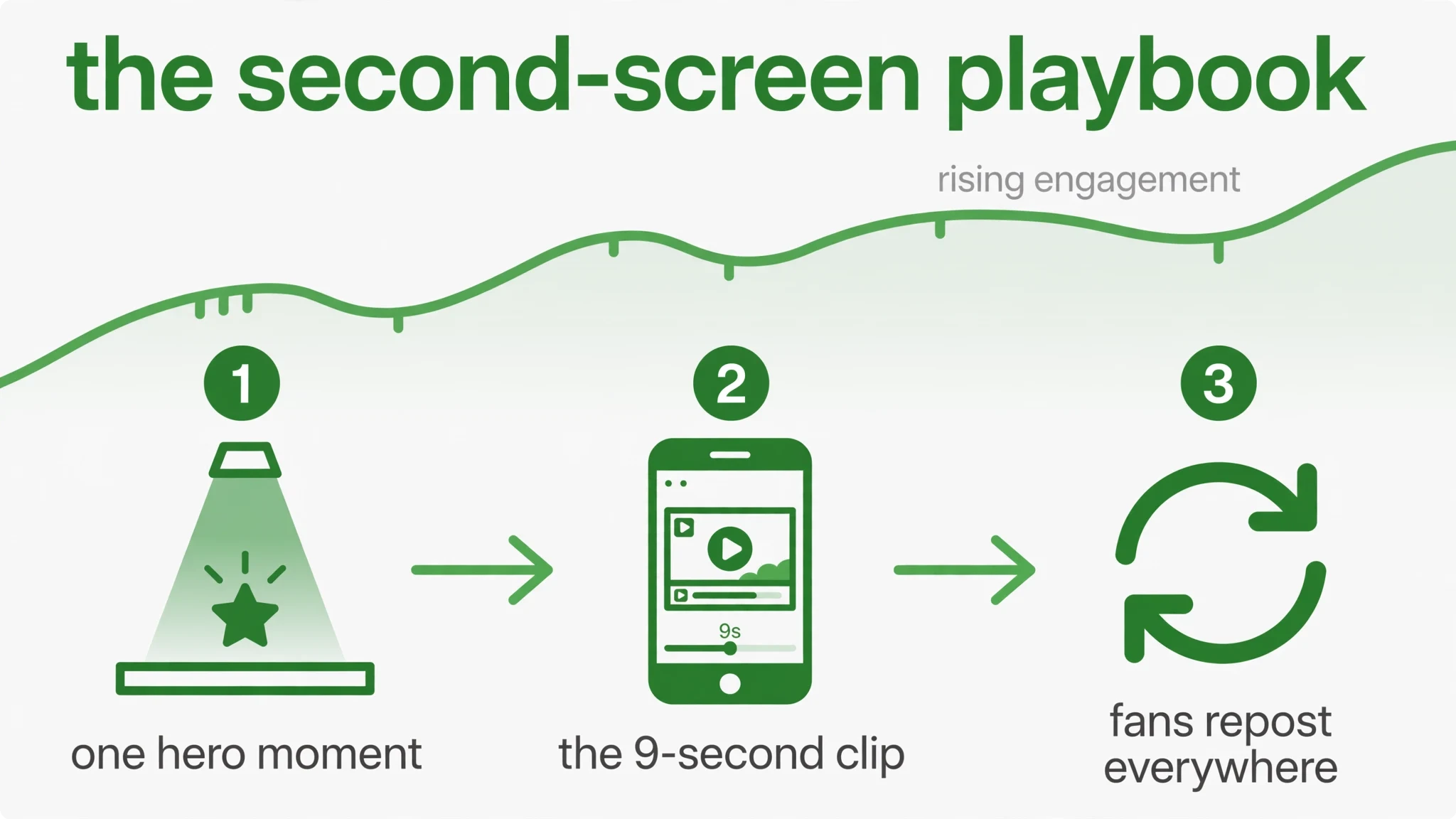
The most-watched footage of the Victoria’s Secret Fashion Show 2026 was not filmed by the broadcast cameras. It was a nine-second clip of Timothée Chalamet applauding from the front row as Kylie Jenner walked past — shot on a phone, shared instantly, and viral within hours. The show’s producers could not have scripted a better distribution asset, but they absolutely staged the conditions for one: the front row was seeded with cameras, family, and famous faces, pointed directly at the moment everyone would want to capture.
Lesson three from the Victoria’s Secret Fashion Show 2026: design one moment in every campaign specifically for the second screen. The runway show is the event; the nine-second clip is the product. Victoria’s Secret has clearly internalized this — the 2024 comeback generated 414 million video views from influencer and creator content alone, and this year’s edition added a first-ever post-show TikTok Live to keep the conversation on social platforms after the stream ended. The brand is no longer producing a show and hoping it gets shared. It is producing shareable moments and wrapping a show around them.
For your own marketing, build the clip before you build the campaign. Ask: what is the nine-second version of this launch? A founder’s reaction, a customer’s first look, a behind-the-scenes reveal — one compact, emotional, phone-friendly moment that strangers will want to repost. Then stage the conditions: good lighting, real people, genuine emotion, and a front row worth filming. The Victoria’s Secret Fashion Show 2026 proves the event is just the factory. The clip is the product, and the product is what travels. Short-form video is the natural home for these moments — our short-form video strategy guide breaks down how to engineer clips that earn their own distribution.
Lesson 4: Let Nostalgia Do the Heavy Lifting
Walk down the 2026 runway in order and you are walking through the brand’s history. Adriana Lima: 21 shows, the most in the event’s history. Alessandra Ambrosio: 20. Candice Swanepoel: 14, returning to the wings she first earned in 2007. Behati Prinsloo, Elsa Hosk, Rosie Huntington-Whiteley, Doutzen Kroes, Jasmine Tookes — a roll call of the golden era, walking alongside newcomers like Natalia Bryant, making her debut at 23. The Victoria’s Secret Fashion Show 2026 did not ask the audience to meet a new brand. It reintroduced them to the one they already loved.
This is the fourth brand revival marketing lesson of the Victoria’s Secret Fashion Show 2026, and it is the emotional core of the whole campaign: nostalgia is the cheapest trust you can buy. A comeback does not start from zero — it starts from memory. Every returning Angel was a walking reminder of the brand’s peak cultural years, and their presence told the audience that the revival is a homecoming, not a pivot.
That matters because comebacks live or die on credibility. A brand that abandoned its icons looks desperate when it returns; a brand that honors them looks confident. Preis framed it exactly this way, saying the strategy is returning to “what’s truly part of our DNA,” like the Angels and the fashion show — “but through a modern lens.”
Use your own history as a trust signal. Anniversary editions, founder stories, “then and now” content, the return of a beloved face or format — these are not sentimental indulgences, they are conversion tools. Nostalgia lowers the audience’s defenses because it replaces skepticism with recognition. But note the discipline in the Victoria’s Secret Fashion Show 2026: the nostalgia was curated, not indiscriminate. The show kept the wings and the Angels and dropped the era’s baggage, pairing heritage casting with new faces and a modern production. Borrow the warmth of your history; leave the parts that dated it.
Lesson 5: Give the Press One Irresistible Detail
Every article written about the Victoria’s Secret Fashion Show 2026 leads with the same fact: the $50 million Fantasy Bra. Not the theme, not the performer lineup, not the venue — the bra. That is not an accident of journalism. It is the product of a PR strategy that gave every outlet one irresistible, headline-ready detail and let it do the heavy lifting for the entire event.
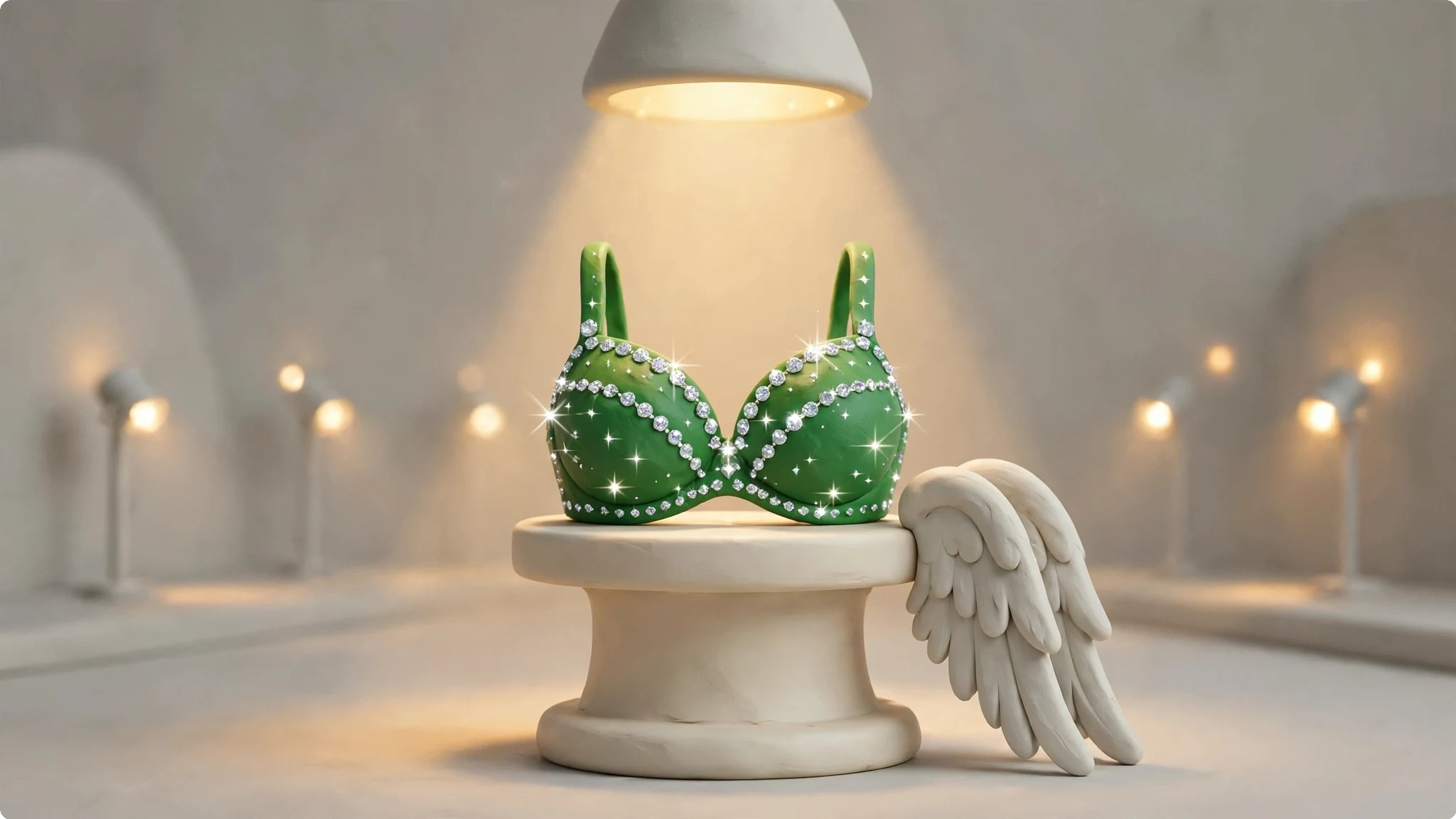
Lesson five from the Victoria’s Secret Fashion Show 2026: engineer a single detail so vivid that the press cannot write about you without it. The Fantasy Bra is the perfect specimen — a concrete object, a superlative attached (“the most expensive in its 30-year history”), a craftsmanship story (15 artisans, 1,000+ hours), and a visual that photographs like a dream. One detail generated thousands of headlines, and every headline carried the brand’s name, the event, and the comeback narrative with it. The bra is not the show; it is the hook the show hangs on.
Your campaigns need a hook with the same properties: concrete, superlative, visual, and story-rich. “Our biggest launch ever” is not a hook. “The first product we built entirely from customer requests, tested in 40 living rooms” is. Founders love abstract positioning; journalists and audiences love specifics. Before your next launch, ask what single detail a stranger would repeat at dinner. If you cannot name it, you do not have one yet — and the Victoria’s Secret Fashion Show 2026 suggests you should not launch until you do. The detail does not have to be expensive. It has to be repeatable.
Lesson 6: Say the Quiet Part Out Loud — Answer Your Audience
The most revealing quotes of the Victoria’s Secret Fashion Show 2026 did not come from the runway. They came from the executives, and they all said the same thing: we listened. When the show returned in 2024 after its hiatus, the brand’s marketing leadership said customers “told us loud and clear that they missed the fashion show.” When Selman revived the Fantasy Bra, he called it “a direct response to fan demand.” When Preis moved the show to Sunday and built watch-party mechanics around it, she explained it came from observing how fans gathered to watch the 2025 event together. The entire revival is framed, publicly and repeatedly, as an answer.
That is brand revival marketing lesson six from the Victoria’s Secret Fashion Show 2026: narrate your comeback as a response, not a reinvention. There is a profound difference. A reinvention says “we were wrong, here is the new us” — it centers the brand’s journey. A response says “you asked, we heard you” — it centers the customer. The first invites judgment; the second invites participation. By crediting the audience for every major decision, Victoria’s Secret turned its harshest critics into co-authors of the comeback. It is much harder to attack a brand that is publicly doing what you asked it to do.
Put this in your own playbook: when you change something, say who asked for it. “You told us checkout was confusing, so we rebuilt it.” “Our most-requested feature is finally here.” Customer-driven language converts because it flatters the reader — they are not being sold to, they are being heard. And it compounds: every answered request trains your audience to make more requests, which gives you more comebacks to stage. The Victoria’s Secret Fashion Show 2026 is, at its core, a very expensive way of saying “you were right.” That sentence, delivered credibly, is one of the most powerful in marketing.
Lesson 7: Turn the Broadcast Into a Gathering
One of the smallest logistical details of the Victoria’s Secret Fashion Show 2026 carries one of the biggest marketing lessons: the show moved from Wednesday to Sunday. Preis’s reasoning was disarmingly simple — Sunday is “an easy day for people to get together.” After watching fans assemble watch parties for the 2025 show, the brand redesigned 2026 to be “much more participatory as a night of fun and friendship,” complete with its first post-show TikTok Live. With the Victoria’s Secret Fashion Show 2026, Victoria’s Secret stopped producing a broadcast and started hosting a gathering.
This is the seventh brand revival marketing lesson of the Victoria’s Secret Fashion Show 2026: design for togetherness, not just viewership. A viewer watches alone; a gathering multiplies. Every watch party is a roomful of people experiencing your brand simultaneously, reacting together, posting together, and — critically — buying together. The Sunday slot, the TikTok Live afterparty, the participatory framing: these are all mechanisms that convert passive viewers into active participants. What people do together outlasts what they watch alone. People forget what they watched; they remember what they did.
The principle scales down beautifully. A product launch becomes a live unboxing event. A webinar becomes a working session with breakout rooms. A sale becomes a countdown the community experiences together — our Fall Back 2026 marketing lessons showed how a predictable calendar moment becomes a full campaign when you give people a shared ritual around it. The mechanism is always the same: give your audience a reason to show up at the same time, in the same (virtual or physical) room, and let the social energy do what advertising cannot. The Victoria’s Secret Fashion Show 2026 understood that in 2026, the event is not the content. The gathering is the content.
Lesson 8: Fuse the Spectacle to Something Buyable
For all its wings and diamonds, the Victoria’s Secret Fashion Show 2026 is, underneath, a retail event. The previous year’s show leaned hard into selling — nearly every look featured bras or core purchasable pieces, with the PINK sub-brand given its own dedicated segment — and the 2026 edition kept that commercial spine inside the fantasy, with PINK once again anchoring the middle of the show. The spectacle is the top of the funnel; the product page is the bottom. At the Victoria’s Secret Fashion Show 2026, the brand simply refuses to let the two drift apart.
Lesson eight from the Victoria’s Secret Fashion Show 2026: never stage a spectacle that does not end at a checkout. Brand awareness without a purchase path is just expensive entertainment. The show’s genius is that it collapses the distance between aspiration and transaction — you watch the fantasy, and the fantasy is wearing the product. Every winged walk is a product demonstration in disguise. The 2024 comeback proved the pipeline works: the show drove 66 million social engagements and a measurable commercial turnaround that is now five quarters deep. Attention that cannot convert is a cost center; attention wired to inventory is a growth engine.
Audit your own marketing for the gap between the show and the shelf. That viral video, that beautiful brand film, that clever stunt — where does the viewer go next? If the answer is “our homepage, eventually,” you have a leak. Build the shortest possible path from the moment of desire to the moment of purchase: shoppable content, launch-linked landing pages, limited runs tied to the event. The Victoria’s Secret Fashion Show 2026 is a masterclass in keeping the fantasy and the fitting room in the same building. Your content should do the same — desire created and desire captured, in one motion.
Lesson 9: Prove the Comeback With Numbers, Not Adjectives
Here is what elevates the Victoria’s Secret Fashion Show 2026 above a pretty relaunch: the receipts. Q2 2026 net sales up 10% to $1.6 billion. Comparable sales up 9%. Five consecutive quarters of sales growth, four of customer growth, and “outsize growth among younger customers” — the exact demographic the revival was designed to win. The 2024 return generated 66 million social engagements and 414 million video views from creator content alone. The brand even changed its stock ticker from VSCO to VSXY in May 2026 — a none-too-subtle signal of intent. Victoria’s Secret is not asking anyone to believe in the comeback. It is showing the math.
The final brand revival marketing lesson of the Victoria’s Secret Fashion Show 2026: let results carry the narrative. Comebacks drown in adjectives — “bold,” “transformative,” “new era” — and audiences have learned to discount all of them. Numbers, on the other hand, are hard to argue with. Every growth quarter, every engagement figure, every raised forecast is a proof point that does the persuading your copy cannot. Note the sequencing: Victoria’s Secret staged the spectacle AND published the scoreboard. The show creates the emotion; the numbers create the belief. Either one alone would be weaker.
Steal the discipline for your own marketing. When you claim a win — a launch, a rebrand, a turnaround — attach the metric. “Our new onboarding flow” becomes “our new onboarding flow lifted trial-to-paid conversion for the third straight quarter.” Specific, directional, and checkable. And when the numbers are not there yet, say what you are measuring and when you will report back; the promise of accountability builds almost as much trust as the result. The Victoria’s Secret Fashion Show 2026 will be remembered for the wings and the diamonds, but it will be believed because of the balance sheet. In brand revival marketing, proof is the whole game.
Conclusion: The Victoria’s Secret Fashion Show 2026 Comeback Playbook
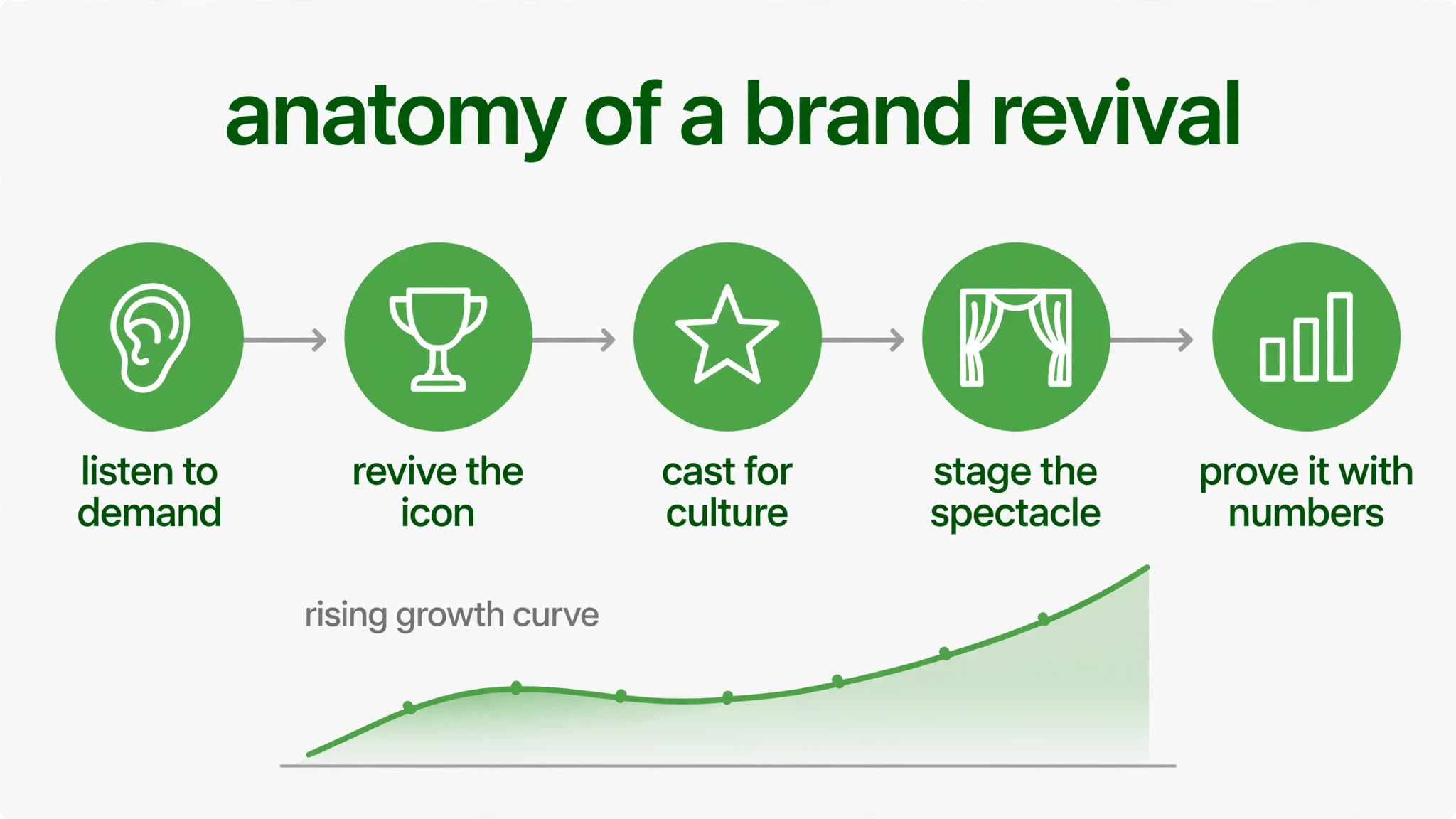
The Victoria’s Secret Fashion Show 2026 will be remembered as a night of wings, diamonds, and a $50 million bra. But for marketers, the Victoria’s Secret Fashion Show 2026 is something more useful: a complete, working blueprint for bringing a legacy brand back to life. Revive the icon your fans already love. Cast for the culture you need, not the craft you have. Design one moment for the second screen. Let nostalgia lower the defenses. Give the press a single irresistible detail. Narrate every change as an answer to your audience. Turn the broadcast into a gathering. Wire the spectacle to something buyable. And prove it all with numbers, not adjectives.
Nine lessons, one runway. The brands that internalize them will not just stage comebacks — they will stage the kind of cultural moments that make comebacks inevitable. The Victoria’s Secret Fashion Show 2026 proves that a legacy is not a liability. Handled with listening, spectacle, and proof, it is the most valuable marketing asset a brand can own.
If you are planning your own brand revival — a relaunch, a repositioning, or a comeback your customers have been asking for — you do not have to choreograph it alone. Talk to the team at KKeyQik — we build revival campaigns with the same mechanics: heritage assets, cultural casting, and content engineered to travel.
Related reading: The ’80s Are Back: 8 Nostalgia Marketing Lessons from the Retro Wave
Want to put this to work for your business? KKeyQik plans and delivers social media campaigns for small businesses, with an in-house team available 24/7. See our social media marketing service or get a quote within 24 hours.
Frequently Asked Questions
The 2026 show, staged October 18 at Sony Pictures Studios in Culver City, was built around the four seasons with a dedicated PINK segment, moved from Wednesday to Sunday to encourage watch parties, added the brand's first post-show TikTok Live and first cinema screenings, and revived the iconic Fantasy Bra for the first time since 2018 — all framed as a direct response to fan demand.
Executive creative director Adam Selman said the return was "a direct response to fan demand." The Fantasy Bra is the brand's most famous showpiece with a 30-year history, so reviving it let Victoria's Secret tap into deep audience nostalgia instead of inventing a new spectacle — a textbook brand revival move of reactivating an icon the audience already loves.
Selman confirmed her casting was "a strategic decision for her global appeal," and a senior brand executive called her a "cultural powerhouse." Jenner brings a massive younger audience that fashion media alone cannot deliver, and her debut in the Fantasy Bra became the single most-covered moment of the show — reach as a casting decision.
The Fantasy Bra is Victoria's Secret's bejeweled showpiece bra, a tradition dating back to 1996 when Claudia Schiffer wore the first version. Over the decades it has been worn by Angels including Heidi Klum, Tyra Banks, Gisele Bündchen, Adriana Lima and Alessandra Ambrosio. The 2026 edition, designed by Jacob Arabo of Jacob & Co. from thousands of natural diamonds, is the most expensive ever made and the first shown since 2018.
The show is the centerpiece of a turnaround strategy under CEO Hillary Super and creative director Adam Selman: return to the brand's DNA (Angels, wings, spectacle) through a modern lens, cast for culture with crossover names, engineer viral social moments, and wire the spectacle to purchasable product. Leadership reports five consecutive quarters of sales growth and strong gains among younger customers.
The lineup mixed heritage and new faces: Adriana Lima (a record 21st show), Alessandra Ambrosio (20th), Candice Swanepoel (14th), plus Behati Prinsloo, Elsa Hosk, Gigi Hadid, Bella Hadid — who opened the show — Barbara Palvin, Ashley Graham, and debutante Natalia Bryant. Musical performers included Megan Moroney, Tate McRae, KATSEYE and Megan Thee Stallion, who closed the show.
The same mechanics scale down: revive a beloved product or campaign your customers already miss, partner with a creator whose audience you need, design one shareable moment per launch, narrate changes as answers to customer feedback, and attach real metrics to every claim. You do not need a runway — you need an icon, an audience, and proof.
The show was engineered for the second screen: a nine-second front-row clip of Timothée Chalamet cheering Kylie Jenner went viral within hours, the event streamed globally on YouTube and social platforms, and the brand added its first post-show TikTok Live. The 2024 comeback had already shown the formula works, generating hundreds of millions of video views from creator content.
Chief marketing and customer officer Elizabeth Preis said Sunday is "an easy day for people to get together." After watching fans organize watch parties for the 2025 show, the brand redesigned 2026 as a participatory "night of fun and friendship" — turning a broadcast into a shared gathering, which multiplies attention and social posting.
The reported business results say yes: Q2 2026 net sales rose 10% to $1.6 billion with comparable sales up 9%, marking five straight quarters of sales growth and four of customer growth, with leadership citing outsized gains among younger customers. The cultural signals — viral moments, record show attendance interest, and sustained press coverage — point the same direction.