

Introduction
The Houston Rockets beat the Golden State Warriors 115-108 on Wednesday night, and within hours the game was one of the most searched terms in the United States. “Warriors vs rockets” passed 100,000 searches and kept climbing, up 1,000 percent on the day. It was not alone. Four more NBA games trended at the same time — Spurs against the Bulls, Lakers against the Bucks, Cavaliers against the Knicks, Celtics against the Raptors — each of them above 100,000 searches.
One night of basketball produced five separate search spikes, and every one of them was a marketing opportunity that lasted about as long as the game itself.
That is the whole point of real-time marketing strategies. Most marketing is planned weeks in advance: the campaign calendar, the content schedule, the ad sets. Real-time marketing is the opposite discipline. It is the ability to spot a moment while it is still happening, say something useful about it, and reach people who are already paying attention. The moment does the hard work of gathering the audience. Your job is simply to be there, with something worth saying, before the moment passes.
The Warriors vs Rockets game is a near-perfect case study in how these moments work, because everything about it was built for speed. The game’s biggest star left after six minutes. The underdog rookie nobody had planned for scored 25 points. An eight-game winning streak ended. Each twist sent a fresh wave of people to their phones to search, post and argue about what they had just seen. And the businesses that understand real-time marketing strategies were the ones ready to meet that wave — not with a scheduled post from Tuesday, but with a reaction published while the game was still on.
This post breaks down what actually happened on Wednesday night, what the latest research says about how fans behave while live sport is on, and seven real-time marketing strategies a small business can borrow — including a five-step playbook, the mistakes that turn a good moment into a public apology, and how to tell whether your real-time marketing actually worked.
What Happened: Rockets 115, Warriors 108 — and Five Search Spikes at Once
The facts first, because the game itself explains why the search spike was so large. The Rockets won 115-108 at the Toyota Center in Houston, ending Golden State’s eight-game winning streak. Kevin Durant led Houston with 20 points, Alperen Sengun added 19 points, 13 rebounds and nine assists, and Amen Thompson chipped in 19. The Rockets moved to 9-3. The Warriors fell to 8-4.
The night turned on a single moment. Stephen Curry, the Warriors’ star and the player most fans had tuned in to watch, left in the first quarter with right abdominal soreness after just six minutes on the court. He did not return. He underwent an MRI after the game, and the results were not immediately known. The Warriors fell behind 35-20 by the end of the first quarter, fought back to tie the game, and then lost it in the fourth. The player who carried them in Curry’s absence was a rookie, Yaxel Lendeborg, who scored 25 points and grabbed 10 rebounds. Brandin Podziemski added 22.
Every one of those details became its own search. “Warriors vs rockets” surged past 100,000 searches. “Steph curry” surged past 100,000 searches too, up 1,000 percent, as fans looked for news on the injury. “Ayesha curry” followed at more than 50,000 searches. Meanwhile the other four games on the night’s schedule produced their own spikes, each above 100,000 searches. A single evening of regular-season basketball — not a final, not a playoff game — generated well over half a million searches across five queries, and that counts only the queries that made the trending list.
For marketers, the pattern matters more than the scoreline. Nobody planned this spike. No brand bought it in advance. It arrived because something unexpected happened in front of a live audience, and millions of people reached for their phones at the same time. That is the raw material of real-time marketing strategies: attention that gathers itself, in minutes, around something people already care about. The question is never whether the moment will come. The question is whether your business is set up to notice it and respond before it is gone. That setup is what real-time marketing strategies are for.
Why This Matters: The Second Screen Is Where Your Customer Sits
The Warriors vs Rockets spike was not an accident of basketball. It was a normal night in the way Americans now watch live sport — and the research published in 2026 makes the scale of that behaviour hard to ignore.
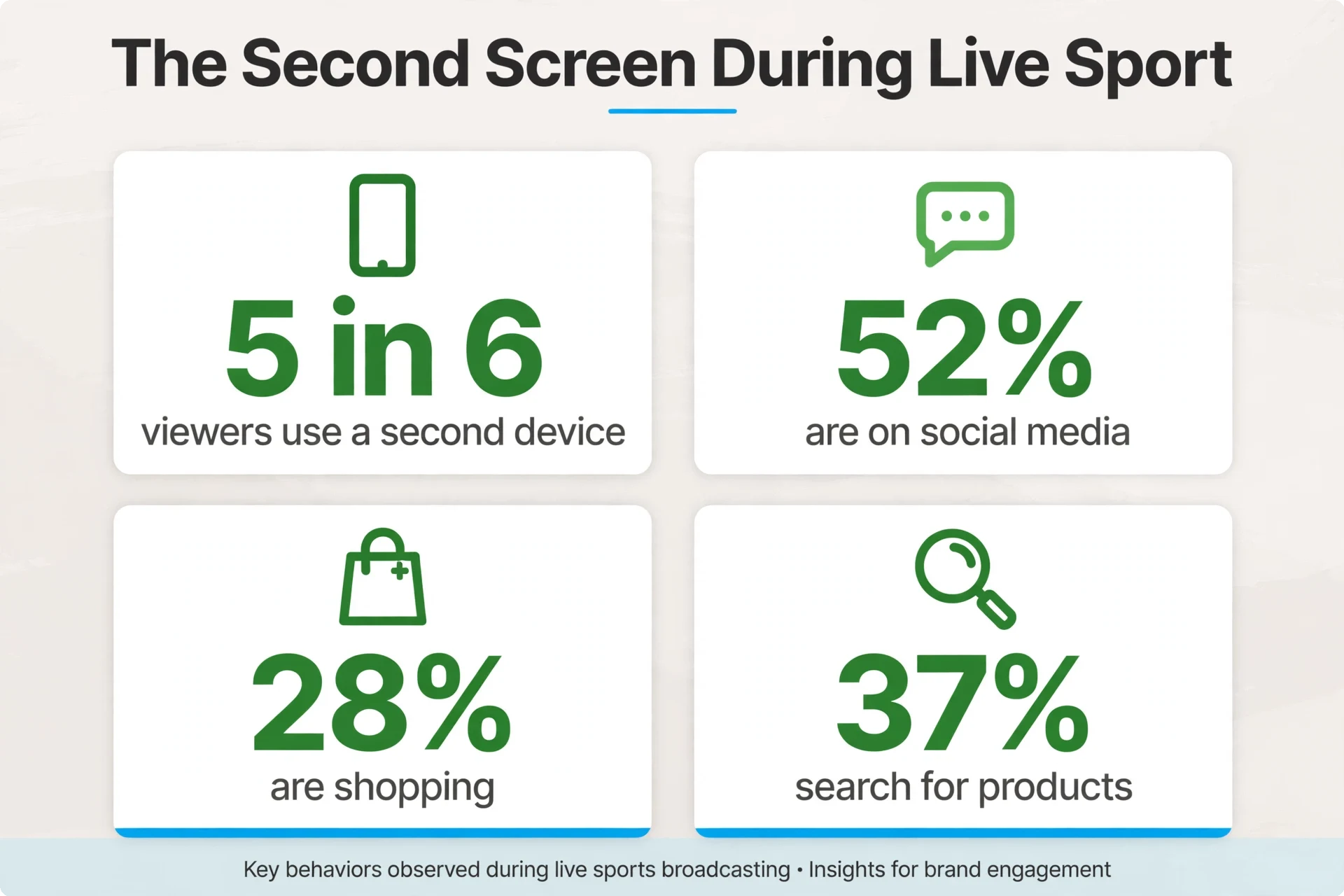
Genius Sports published its Companion Screen report in September 2026, based on a survey of 1,001 adults in the United States. Roughly five in six viewers have a second device in hand while a live game is on. Roughly half use another device often or almost always during the game.
What they do on that second device is the part that should interest any small business: 59 percent are texting or messaging, 52 percent are on social media, 32 percent are browsing generally, 28 percent are shopping, and 22 percent are checking scores and statistics. Among the fans who watch at least weekly — more than half of American adults — the numbers climb higher still: 65 percent text, 57 percent use social media, and a third shop while the game is on.
Hub Entertainment Research found the same pattern from a different angle. In a July 2026 survey of 3,814 sports fans in the United States, 45 percent of fans under 35 said they get most or all of their non-live sports content from social media — more than four times the rate among fans aged 55 and over. And among younger fans who use social media during a live game, 62 percent say that activity is about the game itself. They are not drifting away from the sport. They are watching it through their phones.
The behaviour is not limited to sport, and it is not limited to the United States. Research published in the United Kingdom in September 2026 found that four in five internet users there often use a second screen while watching television. While the television is on, nearly six in ten read email, nearly six in ten message friends, just over half use social media, and more than a third search for products. Search engines are the first destination for 47 percent of second-screen users, ahead of social media at 39 percent. Live sport is the genre most likely to trigger the second screen.
Younger audiences have gone further still. A survey of 2,500 Americans run in May and June 2026 found that 58 percent of 18 to 24-year-olds and 59 percent of 25 to 34-year-olds often follow games through clips, updates or social media instead of watching the full match. A separate global survey of 6,000 fans found that only 39 percent of 18 to 24-year-olds typically watch an entire live event, against 61 percent of fans aged 65 and over. The game is increasingly something people experience in fragments — a clip here, a score update there, a reaction in the group chat — and each fragment is a moment when a business can show up.
Put together, the picture is clear. Live events concentrate attention in a way almost nothing else in marketing still does, and the audience is holding a phone while it happens. The businesses that win from that attention are not the ones with the biggest budgets. They are the ones with the fastest reflexes and the clearest sense of what to say. That is what the seven real-time marketing strategies below are built to deliver.
Lesson 1: Speed Beats Budget
The most famous moment in real-time marketing history cost nothing to distribute. On February 3, 2013, during Super Bowl XLVII, the lights went out in the Superdome and play stopped for 34 minutes. Oreo posted a single image of a cookie in the dark with the line “You can still dunk in the dark.” It earned roughly 15,000 retweets and more than 20,000 Facebook likes within a day, with no media spend behind it. A 30-second television spot on the same night cost around 3.8 million dollars. The tweet reached an audience comparable to that spot, for free.
The lesson most marketers took from that night was the wrong one. They assumed the tweet was spontaneous — a flash of inspiration in a dark stadium. It was not. They treated it as a one-off stunt, when it was really a demonstration of real-time marketing strategies done properly. Oreo and its agency had a command centre running during the game, with around 15 people in the room and an agreed approval chain. They had spent the previous summer publishing topical posts for 100 consecutive days, training the exact process they used that night. The executive who ran the Oreo business later said the tweet took two years to make. Speed looked effortless because the preparation was invisible.
That is the first of these real-time marketing strategies, and it is the one the others depend on: speed beats budget, but speed is a system, not a talent. The post that wins the moment is almost never written from scratch in the moment. It is written from a template, by a person who already has permission to publish, about a moment the team already expected might happen. Oreo did not predict a blackout. They predicted that something unpredictable would happen, and they built a team that could react to it in minutes.
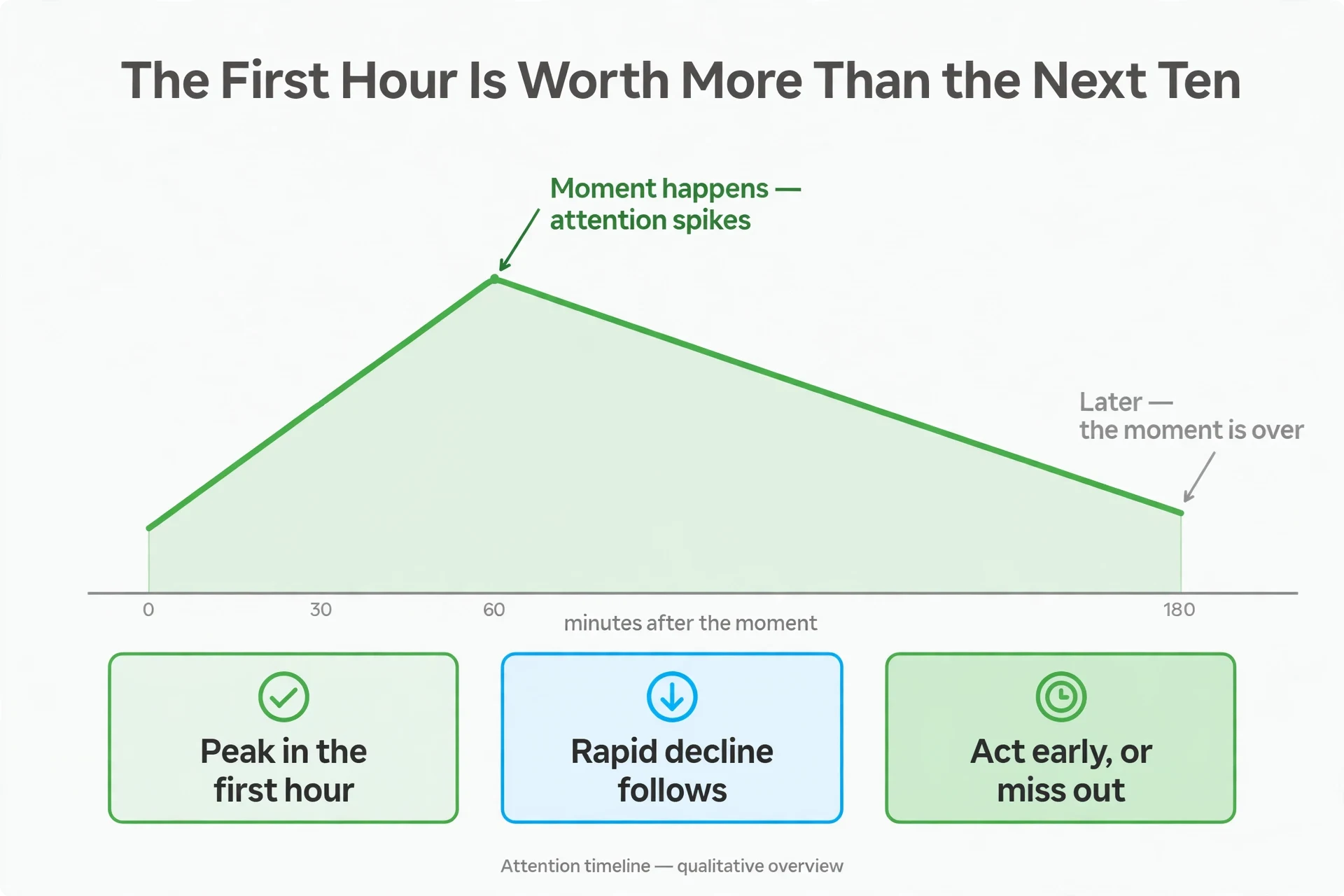
The platforms reward that speed directly. Attention around a moment is highest while the event is still running; a clip posted three hours later has to build a new audience from nothing. Instagram’s own ranking guidance lists how quickly people like, comment, share and save a post among the signals that decide what gets shown. YouTube’s trending charts weigh how fast a video’s views are growing and refresh roughly every 30 minutes.
TikTok’s recommendations lean on how people interact with a video, not on how many followers the account already has. Every platform is, in its own way, telling marketers the same thing: the first hour is worth more than the next ten. Build your real-time marketing strategies around that hour, not around the weekly content calendar.
For a small business, the practical version of this lesson is simple. Decide in advance who can publish without asking permission, and give that person a short list of moments worth reacting to. When the moment comes, the post should take minutes, not hours. If your approval chain needs three people and a legal review, you do not have real-time marketing strategies. You have a press release with a shorter deadline.
Lesson 2: The Moment Is the Media Plan
Most small businesses plan their marketing around their own calendar: the product launch, the seasonal sale, the monthly newsletter. Real-time marketing strategies plan around the audience’s calendar instead — the events people are already going to watch, search for and talk about, whether your business is involved or not.
Live sport is the clearest example, because its calendar is public months in advance. The NBA publishes its schedule before the season starts. So does every other league, every awards show, every major product launch, every local festival. The Warriors vs Rockets game was on that calendar. The Curry injury was not — but the game itself was, and any business that had the game on its watchlist was already halfway to reacting when the injury happened. The predictable event creates the audience. The unpredictable twist inside it creates the spike. You cannot plan the twist, but you can absolutely plan to be watching when it arrives.
The 2025 Singapore Grand Prix shows what that planning looks like at scale. According to Meltwater’s analysis, the race weekend generated more than 431,000 posts and reposts and reached more than two billion users worldwide. Social activity peaked on race day with 138,037 posts, and X accounted for 80.5 percent of the conversation. The brands that won online were not the ones that bought the most ads.
DHL was the most mentioned brand with nearly 5,245 posts. Aramco reached 22 million people. Salesforce generated around 258,000 engagement actions, the most of any sponsor. And the single most engaging story of the weekend was not about the race at all — it was Lewis Hamilton’s tribute to his late dog, which passed one million engagement actions. The brands that participated in the narrative, rather than just appearing next to it, took the biggest share of attention.
A small business can run the same logic at a local scale. The calendar of moments worth watching is not limited to national television. It includes the high school championship game, the town festival, the county fair, the first snow, the local team’s playoff run, the opening of a new venue across the street. Each of those moments gathers a local audience that is already searching and posting. The real-time marketing strategies that work for a small business start with a simple list: ten moments in the next three months when your customers will be paying attention to something other than you — and one idea for each about what your business could honestly add to the conversation.
Lesson 3: Meet People on the Second Screen, Not the First
The Genius Sports numbers from the section above contain the most useful detail in this entire post, and it is easy to miss. When fans are watching a live game with a phone in their hand, 28 percent of them are shopping. A third are browsing generally. More than a third are searching for related information. The second screen is not a distraction from the game. It is a shopping and searching environment that happens to have a game on in the background.
That changes what good real-time marketing strategies look like. The old model was built for the first screen: buy the television spot, run the arena signage, sponsor the broadcast. The new model is built for the device in the hand. The fan who just watched a rookie score 25 points is, in the same minute, searching for that rookie’s name, checking his stats, and looking at his jersey. The fan who just saw a product in a courtside ad is searching for it before the next timeout. The businesses that show up in those searches did not buy their way in during the game. They published the thing people were about to search for, before the game started.
Hub’s research adds the generational detail. Among fans aged 13 to 34 who use social media during a live game, 62 percent say the activity is about the game itself — and 65 percent of younger fans who post during a game are posting about that game. The second screen is pointed back at the first screen. That is why a post about the game, published during the game, travels further than a post about your product published at the same time. It is riding a wave of attention that is already moving in that direction.
For a small business, the practical move is to think in searches, not just in posts. Before a local event or a big game, ask what people will search for while it is happening, and publish something that answers it. A restaurant near the arena can publish the best places to eat after the game. A sports shop can publish the rookie’s story and the gear he wears. A plumber can publish the guide to fixing the thing that breaks every winter. The format does not matter much. What matters is that the page exists, answers the question plainly, and is live before the spike arrives — because the spike will not wait for you to write it.
Among real-time marketing strategies, publishing the answer before the spike is the cheapest to run and the hardest to copy. That is one of the most reliable real-time marketing strategies there is: be the clearest answer to the question people are about to ask.
Lesson 4: Say Something Only You Can Say
For every Oreo blackout tweet, there are a dozen real-time marketing attempts that ended in a public apology. The pattern is always the same: a brand sees a trending topic, forces its product into the conversation, and discovers too late that the moment was not theirs to use.
DiGiorno Pizza used a hashtag about domestic violence to sell pizza. Kenneth Cole tied a product promotion to unrest in the Middle East. J.C. Penney drew backlash for a tone-deaf attempt to ride a live moment. Each of these brands had the speed. Each of them lacked the judgement. They treated a trending topic as free attention, and the audience treated them as intruders.
The Oreo tweet worked for the opposite reason. It was not just fast. It was true to the brand, it was light in tone, and it was about a situation — a dark stadium — that a cookie brand could honestly joke about. It tied back to the product without forcing the product into a conversation that had nothing to do with it. The brand’s own account of the night makes the point clearly: the team in the room had judgement and an approval chain, and they chose to wait for a moment that fit rather than jumping on the first trend that appeared.
That is the fourth of these real-time marketing strategies, and it is the one that protects the other six: say something only you can say, and say nothing when you cannot. The test is simple. Before you publish, ask whether a customer who knows your business would recognise the post as yours if your logo were removed. If the answer is no — if any business in any industry could have posted the same thing — delete it. Generic reactions to trending topics are invisible at best and offensive at worst. Specific reactions, grounded in what your business actually does and knows, are the ones people remember and share.
There is a second test, and it matters more. Ask whether the moment involves someone’s pain, loss or misfortune. The Curry injury is a good example. A sports drink brand can legitimately talk about recovery and conditioning. A business with no connection to sport or health that jokes about an injured player is not being clever. It is being careless, and the audience will notice faster than any approval chain can. The moments that reward real-time marketing strategies are the joyful, surprising and impressive ones. The moments that punish them are the ones where a brand mistakes someone else’s bad day for its own opportunity.
Lesson 5: Build the War Room Before the Moment
The Oreo story has one more detail that small businesses usually miss. The tweet was not the work of a single clever social media manager. It was the work of a room: strategy, creative, community, technology and account people, sitting together with brand executives, watching the same game, with the authority to publish. The company had spent a summer running 100 consecutive days of topical posts, not because those posts were individually brilliant, but because the practice trained the team to make decisions quickly and together.
A small business does not need a room full of people. It needs the same three things the room provided: a watchlist, a template, and a decision-maker.
The watchlist is the list of moments from Lesson 2 — the games, the local events, the seasonal dates, the product launches in your industry. Ten moments, three months, one line each. The template is a set of half-written posts for the kinds of moments you expect: a win, a surprise, a record, a local story. Leave blanks for the name, the number and the detail. The decision-maker is one person — named in advance — who can publish without asking anyone else. If that person is you, say so. If it is a member of your team, tell them, and mean it.
Then rehearse. Once a month, pick a moment from the watchlist and run the drill: the moment happens, the decision-maker writes the post from the template, and it goes out within 30 minutes. Time it. The first time you do this, it will feel slow and awkward. The fifth time, it will feel routine. That routine is the whole advantage.
It is also what separates real-time marketing strategies from improvisation: the reaction looks spontaneous because the system behind it is not. When the real moment arrives — the Curry injury, the blackout, the local upset nobody saw coming — your business will react while competitors are still drafting an email to ask for permission. Among all the real-time marketing strategies in this post, this one is the least glamorous and the most valuable: preparation is the only part of speed you can control.
There is one more piece of preparation worth doing in advance, and it costs nothing. Write down, in a single sentence, what your business will never post about. Tragedies, injuries, deaths, disasters, other people’s misfortunes. Put it where the decision-maker can see it. The brands that apologised after a real-time marketing failure did not lack speed. They lacked a line they had agreed not to cross, written down before the moment arrived.
Lesson 6: Turn the Spike into Something Searchable
Search is the part of real-time marketing strategies that most small businesses ignore, and it is the part with the longest shelf life. A social post about a moment lives for hours. A page that answers the question behind the moment can rank for weeks.
Look at what happened on Wednesday night. The game ended, and the searches did not stop. People searched for the score, for Curry’s injury, for the MRI result, for the rookie who scored 25 points, for the next game on the schedule. Each of those searches was a question, and the pages that answered it clearly and early earned the traffic. Google’s own trending charts weigh how fast a video’s views are growing and refresh roughly every 30 minutes. The search results page works the same way in practice: fresh, clear, factual pages rise while the topic is hot.
The practical version of this lesson has two halves. The first half is speed: publish the answer while the spike is still rising, not the next morning. The second half is structure: write the answer the way people search. Short paragraphs. Plain language. The score, the key fact, the next step — in the first three sentences, not buried at the bottom. Search engines and AI assistants both favour pages that answer a question directly, with clear facts and consistent information. A page that states the score, the injury update and the next game date in plain language will outrank a clever post that makes the reader work for the same facts.
This is also where real-time marketing strategies connect directly to the rest of your marketing. The spike brings the visitor. The page keeps them. A restaurant that publishes the post-game guide can link it to the menu. A shop that publishes the rookie’s story can link it to the product page. A service business that publishes the seasonal guide can link it to the booking page. The moment is the doorway. The rest of your site is the room behind it.
Build the doorway while the crowd is outside, and make sure the room is worth entering — because the traffic a live moment sends you is the most valuable traffic there is: people who arrived with a question already in mind and a phone already in hand.
Lesson 7: Measure the Hour, Not the Week
The final lesson is about measurement, and it is the one that decides whether a business keeps doing real-time marketing or gives up after one quiet post. Most marketing is measured in weeks: the monthly report, the quarterly review, the campaign retrospective. Real-time marketing has to be measured in hours, because that is how long the moment lasts. That is why real-time marketing strategies need their own scorecard, separate from the monthly report.
Emplifi’s analysis of sports social media puts it plainly: reach is cheapest in the minutes right after a decisive play, and that window closes quickly. In one global football tournament, Emplifi tracked more than 20 million public conversations across X, Instagram, Facebook and YouTube. The accounts that were ready in those windows reached people who did not follow them yet. The accounts that posted the next day reached their existing audience and nobody else.
The research also warns against measuring the wrong thing. A spike in mentions during a match is easy to spot. It is far harder to determine whether that spike reflects excitement, frustration or confusion — and volume without sentiment is noise. When NBA veteran Pau Gasol announced his retirement, English-language tweet volume grew nearly 200 percent within an hour. The volume told the story. But for a brand, the question is not how many people mentioned the moment. It is how many of them felt something positive about the business that joined the conversation.
There is a second measurement trap. In a study of a livestreamed match with more than 52,000 viewers, researchers found that 96 percent of the audience never sent a single chat message or virtual gift, while a tiny segment of about 1.4 percent — the “super co-creators” — sent an average of 77 messages and 538 gifts each. A small number of highly active fans produces most of the visible activity. If you judge your real-time marketing strategies by likes and comments alone, you are measuring the loudest 1.4 percent and ignoring the 96 percent who watched, searched and quietly decided.
So measure the hour, and measure the right things. In the first hour after a moment, track engagement velocity — how fast the likes, shares and saves are arriving — and follower growth, because a moment that reaches non-followers is doing its job. Track the questions people ask in the replies, because a fan asking whether tickets are still available for the next home game is a sale, not a metric.
Track the searches: did your page about the moment get found, and did the visitor click through to anything else? And then, the next morning, write down what worked and what did not, in three lines, while you still remember. That note is the cheapest competitive advantage in real-time marketing strategies. Most businesses never write it down. The ones that do get faster every single time.
The 5-Step Real-Time Marketing Playbook for Small Business
The seven lessons above compress into a playbook any small business can run without hiring anyone. It takes one afternoon to set up and a few minutes to run each time a moment arrives.
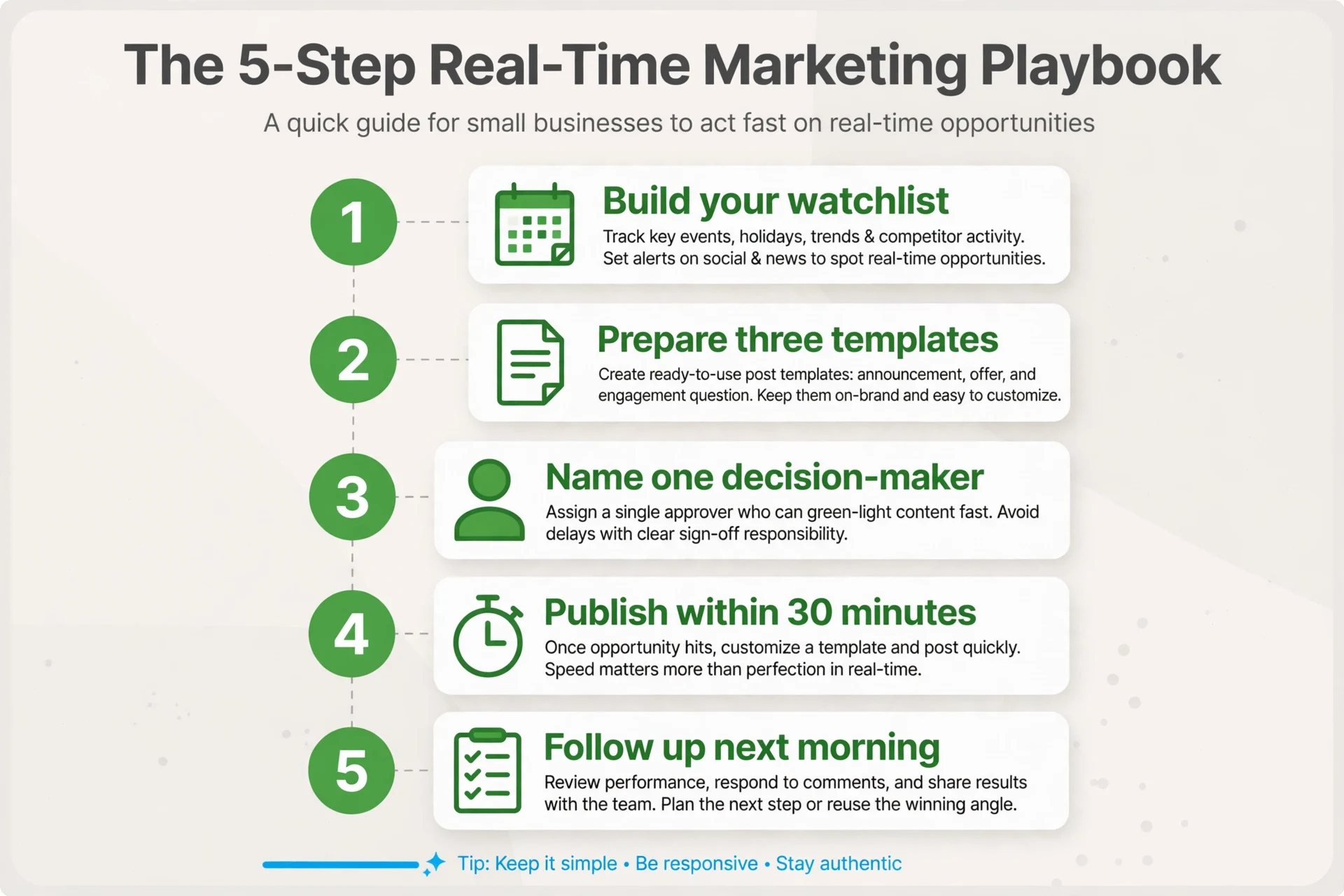
Step 1: Build your watchlist. Write down ten moments in the next three months when your customers will be watching, searching or talking about something. Include the big games, the local events, the seasonal dates and the product launches in your industry. Put the dates in a shared calendar with a reminder the day before.
Step 2: Prepare three templates. One for a win or a record, one for a surprise, one for a local story. Each template is half a post: the structure, the tone, the call to action — with blanks for the name, the number and the detail. Write them when you are calm, not when the moment is happening.
Step 3: Name one decision-maker. One person who can publish without asking permission. Give them the watchlist, the templates and the one-sentence list of things the business will never post about. If that person is you, the job is already done.
Step 4: Publish within 30 minutes. When the moment arrives, fill in the template, check it against the never-post list, and publish. Post the social version first, then the search version — a short page or post that answers the question people are about to ask. Speed matters more than polish. A good post in 20 minutes beats a perfect post in three hours, because in three hours the moment is over.
Step 5: Follow up the next morning. While the moment is fresh, write down three lines: what happened, what you posted, what the numbers said in the first hour. Then post the follow-up: the recap, the result, the next date on the watchlist. The follow-up is where the moment turns into a relationship, because it gives the new people who found you yesterday a reason to come back tomorrow — and it is where one-off real-time marketing strategies become a system that compounds.
That is the whole system. It is not expensive, it is not complicated, and it does not require a command centre. It requires a list, three templates, one decision and the discipline to publish fast. The businesses that run it will not win every moment. They will win enough of them that, over a season, the moments add up to an audience they could never have bought.
Mistakes to Avoid
Three mistakes undo more real-time marketing strategies than any other. The first is jumping on a tragedy. If the moment involves someone’s injury, loss or misfortune, stay quiet unless your business has a genuine, direct connection to the subject — and even then, keep it respectful and brief. The audience forgives a missed moment. It does not forgive a brand that treats a bad day as a marketing opportunity.
The second is forcing the product. A post that shoehorns your service into a moment that has nothing to do with it reads as an intrusion, and it is the fastest route to the apology posts that fill marketing case studies for the wrong reasons. If the connection between the moment and your business is not obvious in one sentence, there is no connection. Skip it.
The third is posting late and calling it real-time. A reaction published the next morning is not real-time marketing. It is a recap, and recaps compete with every other recap published that morning. If you missed the hour, do not pretend you were there. Publish the follow-up instead — the analysis, the lesson, the next date — and be honest that it is one. Your audience will respect the honesty more than they would have respected a late joke.
Conclusion
The Rockets beat the Warriors 115-108 on a Wednesday night in Houston. Stephen Curry left after six minutes. A rookie scored 25 points. An eight-game winning streak ended. And within hours, five NBA games had each passed 100,000 searches, with millions of fans watching on one screen and searching, posting and shopping on another.
None of that was planned by a brand. All of it was available to any business that was watching. That is the promise of real-time marketing strategies: the audience gathers itself, the moment supplies the story, and the only thing your business has to bring is speed, judgement and something honest to say. The businesses that build the watchlist, prepare the templates and name the decision-maker — the ones that treat real-time marketing strategies as a system, not a stunt — will be ready when the next moment arrives. The ones that wait for permission will read about it the next morning, in someone else’s post.
The next moment is already on the calendar. The only question is whether your business will be watching when it happens.
If you want help turning these real-time marketing strategies into a system for your business — the watchlist, the templates, the social content and the search pages that catch the spike while it is still rising — talk to the team at KKeyQik. We build SEO, social media and video marketing campaigns for small businesses that need their marketing to move at the speed their customers do, and we would be glad to help you plan yours.
For more on turning big cultural moments into small business marketing, see our breakdown of the Coachella 2027 lineup’s event marketing lessons, our guide to the Switch 2 Black Friday rush, and our look at Spotify Wrapped’s marketing playbook.
Frequently Asked Questions
Real-time marketing is the practice of reacting to live events, trends and breaking moments as they happen, rather than only running campaigns planned weeks in advance. A brand watches for moments its audience already cares about — a big game, a local event, a cultural story — and publishes something useful about it while attention is still peaking. The moment gathers the audience; the brand's job is to be there with something worth saying before the moment passes.
The Houston Rockets beat the Golden State Warriors 115-108 on Wednesday night at the Toyota Center in Houston, ending the Warriors' eight-game winning streak. Stephen Curry left in the first quarter after just six minutes with right abdominal soreness and did not return. Rookie Yaxel Lendeborg led the Warriors with 25 points, while Kevin Durant scored 20 for Houston and Alperen Sengun added 19 points, 13 rebounds and nine assists.
Several things happened at once: a star player left injured minutes into the game, an unheralded rookie stepped up, and an eight-game winning streak ended. Each twist sent fans searching for updates. "Warriors vs rockets" passed 100,000 searches, "steph curry" did the same, and four other NBA games trended simultaneously — proof that a live event with an unexpected twist creates search demand no campaign could buy in advance.
Within the first hour. The conversation about a moment peaks while the event is still live, and the platforms reward early engagement — fast likes, comments, shares and saves are signals that decide what gets shown. A clip or post published three hours later has to build a new audience from nothing. For a small business, the realistic target is a good post in 20 to 30 minutes, not a perfect one the next morning.
During Super Bowl XLVII in February 2013, the stadium lights went out for 34 minutes. Oreo posted a single image of a cookie in the dark with the line "You can still dunk in the dark." It earned roughly 15,000 retweets and more than 20,000 Facebook likes within a day, with no media spend behind it. The tweet looked spontaneous, but it came from a prepared command centre with an agreed approval chain — the team had spent the previous summer practising topical posts for 100 consecutive days.
Newsjacking is one form of real-time marketing: injecting a brand into a breaking news story while it is still developing. Real-time marketing is broader — it covers any fast reaction to a live moment, including games, local events, seasonal dates and product launches. The discipline is the same either way: speed, relevance and judgement. A forced connection to a trending topic usually backfires, which is why the brands that do it well prepare in advance and skip moments that do not fit them.
Start with a watchlist of ten moments over the next three months: the big games your customers watch, local events and festivals, seasonal dates, and product launches in your industry. Add the moments only your town cares about — the high school championship, the county fair, the first snow. Each one gathers a local audience that is already searching and posting, and each one is a chance to publish something genuinely useful.
You need three things, none of which requires hiring anyone: a watchlist of upcoming moments, three half-written templates for the kinds of moments you expect, and one named decision-maker who can publish without asking permission. Rehearse once a month by running the drill on a moment from the watchlist. After a few rehearsals, reacting in 30 minutes feels routine rather than stressful.
Tragedies, injuries, deaths, disasters and other people's misfortune. If the moment involves someone's pain or loss, stay quiet unless your business has a genuine, direct connection to the subject — and even then, keep it respectful and brief. The audience forgives a missed moment. It does not forgive a brand that treats a bad day as a marketing opportunity. Write the line down before the moment arrives, so nobody has to decide under pressure.
Measure the first hour, not the month. Track how fast engagement arrives, whether you gained followers who did not follow you before, and what questions people ask in the replies — a fan asking about tickets for the next game is a sale, not just a metric. Track the searches too: did your page about the moment get found, and did visitors click through to anything else? Then write down three lines the next morning — what happened, what you posted, what the first-hour numbers said — so each moment makes the next one faster.