

Introduction
On Friday morning, November 6, 2026, Elon Musk posted a single sentence on X that ended one of the most talked-about product stories of the decade. Tesla, he wrote, will be winding down production of the Cybertruck at Gigafactory Texas around the middle of next year, to make room for increased Cybercab production. Within hours, searches for “Cybertruck” had passed 50,000 in the United States, up 1,000 percent on Google Trends, and the trend was still active a day later. The stainless-steel pickup that arrived trailing a million reservations and a shattered window is heading for the exit after a production run of about three and a half years.
This post is not an obituary for a truck. It is a marketing case study, and it is an unusually generous one, because the Cybertruck got almost everything about launch marketing right and almost everything about sustaining demand wrong. The same campaign that filled a reservation book with more than a million names could not fill a factory built for 250,000 trucks a year. The same design that made the vehicle impossible to ignore made it impossible for most pickup buyers to imagine owning. The same announcement style that turned a product reveal into a global event eventually had to deliver the news that the product was ending.
For a small business owner, that contrast is the whole point. You will probably never launch a product with a million reservations, and you will probably never have to wind one down on a public stage. But the forces that decided the Cybertruck’s fate — the gap between attention and demand, the cost of a bold promise, the fragility of borrowed attention, the discipline of knowing when to stop — operate at every scale. The seven lessons below are drawn from what actually happened, with the numbers checked against the reporting, and each one ends with something you can apply to your own business this week.
What Actually Happened to the Cybertruck
The timeline is short, and that brevity is part of the story. Tesla revealed the Cybertruck in November 2019 at a promised starting price of $39,900, with first deliveries following in December 2023, about two years later than originally planned. The truck that arrived cost far more than the one that was announced: Tesla’s configurator now lists the dual-motor all-wheel-drive version at $74,990, the premium all-wheel-drive at $84,990, and the Cyberbeast at $99,990. The range, too, came in below what the 2019 reveal had suggested. From the beginning, the delivered product and the promised product were two different things, and buyers noticed.
The sales figures tell the rest. Tesla does not report Cybertruck deliveries as a standalone number, so the best available picture comes from industry estimates. Kelley Blue Book puts United States sales at 38,965 in 2024, then 20,237 in 2025, a fall of 48 percent, and 11,586 across the first nine months of 2026, down 28 percent on the same period a year earlier.
Cox Automotive estimated just 4,323 Cybertrucks sold in the third quarter of 2026. Tesla’s own “Other Models” category, which now consists almost entirely of the Cybertruck after Model S and Model X production ended in April, delivered 8,295 vehicles in the third quarter of 2026, down 48 percent year on year and the lowest total for the category since the second quarter of 2021. Add the Kelley Blue Book figures together and you arrive at roughly 70,000 Cybertrucks sold in the United States across 2024, 2025, and the first nine months of 2026.
Set those numbers against the plan and the scale of the miss becomes clear. Tesla built the Cybertruck line for 250,000 units a year, and its shareholder communications still list more than 125,000 units of installed capacity. At its current pace the truck is selling at roughly a tenth of the annual volume the line was designed for, and roughly a quarter of what is actually installed. The factory floor is the scarcest resource in the story, which is exactly why Musk’s announcement framed the wind-down as a matter of space: the Gigafactory Texas floor now needs to build Cybercabs instead.
Two other developments in the weeks before the announcement pointed the same way. On October 22, 2026, Tesla told reservation holders in Australia and New Zealand that plans to produce the Cybertruck for those markets had been discontinued and that every reservation would be cancelled, pulling the truck from its Australian website entirely. And the vehicle had accumulated 11 safety recalls in the United States by November 6, 2026, including software fixes delivered over the air. None of those facts alone ends a product. Together, they describe a programme that had stopped growing in every direction at once.
What is not confirmed matters as much as what is. Musk’s post says production winds down “around the middle of next year” — no month, no final build date, no final model year.
Reuters has noted that it remains unclear whether production will stop entirely or shift to another facility, and Gigafactory Texas is the only plant known to be equipped to build the truck’s specialised components. The Cybertruck’s lead engineer, Wes Morrill, posted that the vehicle “was an incredible technology development platform and lives on through Cybercab,” and confirmed that Tesla will maintain spare parts and service support for existing owners. The careful reading is that the Cybertruck as a production programme is ending at its only factory in mid-2027, and that anything beyond that is speculation. For marketers, the lesson is already complete either way: the product’s story is now a case study in how a launch can succeed and a business can still fail.
Why “Cybertruck” Searches Exploded Overnight
A search surge is not simply a popular topic. It is a sudden, measurable spike in demand for answers, concentrated in a window of hours, and the Cybertruck announcement produced a textbook one. Three forces combined to create it, and each of them is worth understanding, because the same three forces drive almost every surge a small business might ride.
First, the Cybertruck is a cultural object, not just a vehicle. People have argued about it since the day of the reveal — its looks, its price, its politics, its place in the pickup market — and an announcement about its future touches all of those arguments at once. A product that generates strong opinions in both directions generates searches in both directions, because supporters want to know what happens next and critics want to know whether they were right. That is why the trend was still active a day later: the argument did not end with the announcement, it restarted.
Second, the announcement contradicted the story Tesla itself had been telling. Earlier in 2026, Musk had described the Cybertruck as the best product Tesla had ever made. A wind-down announced months later is a reversal, and reversals are newsworthy in a way that steady progress never is. Journalists, analysts, and owners all had the same question at the same time — what changed? — and they all went looking for the answer in the same window. Surprise is the most reliable accelerant of a search surge, and this one had it in full.
Third, the timing was perfect for attention. A Friday morning announcement gives the news cycle a full day to build, gives the weekend’s social feeds something to argue about, and gives every automotive and business outlet a reason to publish an explainer. By the time the trend peaked, the coverage had already split into two camps — the obituaries, including a widely shared one headlined as a farewell to a vehicle that was “unloved, unwanted, and utterly absurd,” and the careful explainers noting that a wind-down is not yet a discontinuation. That split is itself a reason to search: when the headlines disagree, readers go looking for the facts.
For a marketer, the staying power is the point. Most news surges fade within a day. A Cybertruck surge behaves differently, because the questions it raises — what went wrong, what does it mean for Tesla, what happens to owners — stay relevant for weeks, and the answers are useful to anyone who launches, prices, or kills a product. The businesses that publish something genuinely useful while the surge is still building will keep earning traffic from it long after the news cycle moves on. That is the opportunity this post is built to capture, and the lessons below are the substance that makes it worth capturing.
1. Attention Is Not Demand
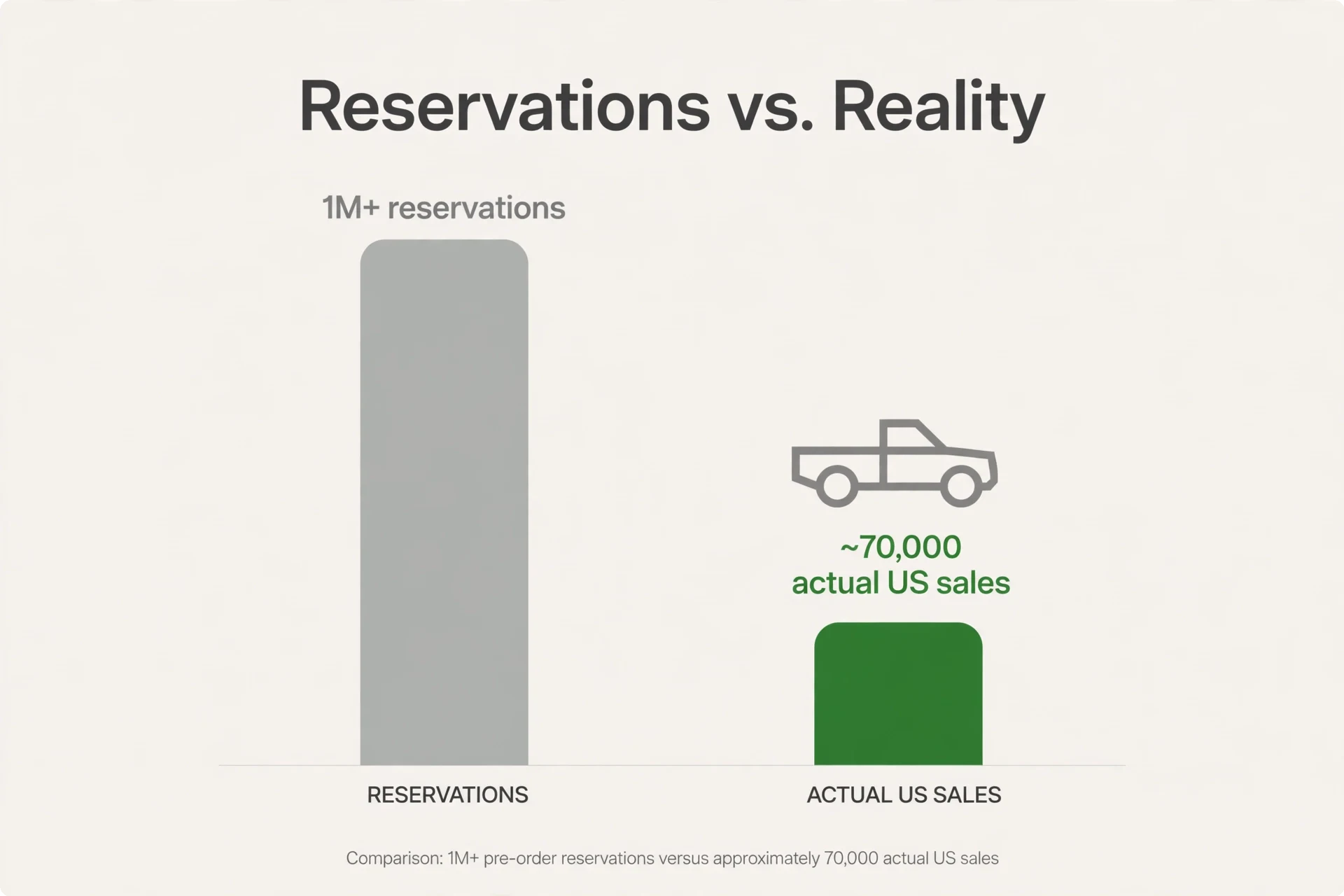
The most important number in the Cybertruck story is not a sales figure. It is the gap between two numbers: more than one million reservations, claimed by Musk at the end of 2023, against roughly 70,000 Cybertrucks actually sold in the United States across 2024, 2025, and the first nine months of 2026. A reservation book that large should have guaranteed years of demand. Instead, Tesla worked through its backlog of eager early buyers and discovered that the queue behind them was far shorter than the headline suggested.
The reason is simple, and it is the first lesson. A reservation is not a purchase. Reserving a Cybertruck cost almost nothing, committed the buyer to nothing, and could be cancelled at any time. It measured curiosity, not intent. A million people were willing to put their name on a list for a radical-looking truck at a promised $39,900. Far fewer were willing to hand over $74,990 or more for the truck that actually arrived, years later, at nearly twice the promised price. The reservation count was real, and it was also almost entirely uninformative about how many trucks Tesla would sell.
Small businesses make the same measurement error constantly, at smaller scale. An email list of ten thousand names, a waitlist of five hundred, a viral post with a hundred thousand views, a launch page with a thousand sign-ups — each of these feels like demand, and each of them is, at best, a measure of attention. Attention converts to demand only when someone pays, and the conversion rate between the two is usually far lower than the excitement of the moment suggests. The discipline is to measure the conversion, not the applause. If a thousand people joined your waitlist and forty bought, your demand is forty, and your marketing problem is the nine hundred and sixty who did not convert — not the size of the list.
There is a practical version of this lesson for every launch. Before you celebrate a waitlist, a following, or a full inbox, ask what it cost the person to join. If the answer is nothing — no payment, no deposit, no commitment, no friction of any kind — then treat the number as a measure of curiosity and plan accordingly. Build your forecasts on the people who have paid, not the people who have expressed interest. And when you report results to yourself, report the conversion rate alongside the headline number, every time. The Cybertruck’s reservation book was the most impressive vanity metric in automotive history. It was also a trap, because it let everyone involved believe the demand question had already been answered. It had not. It had only been postponed.
2. A Polarising Product Narrows Your Market
The Cybertruck’s design was its marketing. The stainless-steel wedge looked like nothing else on the road, and that was the point: a vehicle that photographs like a concept car, that is recognisable from a hundred metres away, that turns every traffic light into a conversation. In a market where most pickups are variations on the same shape, Tesla built something that could not be mistaken for anything else. The design did exactly what it was supposed to do. It made the Cybertruck famous.
It also made the Cybertruck’s market small. Pickup buyers are among the most conservative buyers in the American vehicle market. They buy trucks for work, for towing, for hauling, for fitting into a life built around a particular kind of vehicle, and most of them want a truck that looks like a truck. A design that thrills one buyer in ten and alienates the other nine is not a flaw in the design. It is a choice about who the product is for. The trouble is that the choice has arithmetic attached to it: if your design appeals to a tenth of the market, your sales ceiling is a tenth of the market, no matter how passionately that tenth feels about you. Tesla’s installed capacity assumed a mass-market product. Its design delivered a niche one.
This is the second lesson, and it is the one small businesses most often get wrong in the other direction. Differentiation is essential — a business that looks like everyone else has no reason to be chosen — but differentiation that shrinks your addressable market must be a deliberate decision, made with honest maths behind it. An edgy brand voice, a radical redesign, a positioning statement that deliberately excludes most buyers: all of these can be brilliant strategies, provided you have counted the people left in the room after the exclusion and confirmed that the room is big enough to sustain you.
The failure mode is not the boldness. It is the surprise. Tesla was surprised, or at least its capacity planning was, by the size of the audience that actually wanted a stainless-steel wedge. A small business that rebrands into a niche should never be surprised by the same arithmetic.
The test to run before you commit is simple. Describe the customer your bold choice excludes, estimate how many of them there are, and ask whether the customers who remain can support the business you are building. If the answer is yes, proceed with confidence — a small, passionate market is a wonderful thing to own. If the answer is no, or if you do not know, then the bold choice is a gamble, not a strategy. The Cybertruck’s design was never the problem in isolation. The problem was a mass-market factory built for a niche-market product, and that mismatch is a planning failure, not a design failure. Your version of the same mistake is a service, a package, or a brand built for a market that is smaller than your ambitions require.
3. Your Launch Price Is a Promise
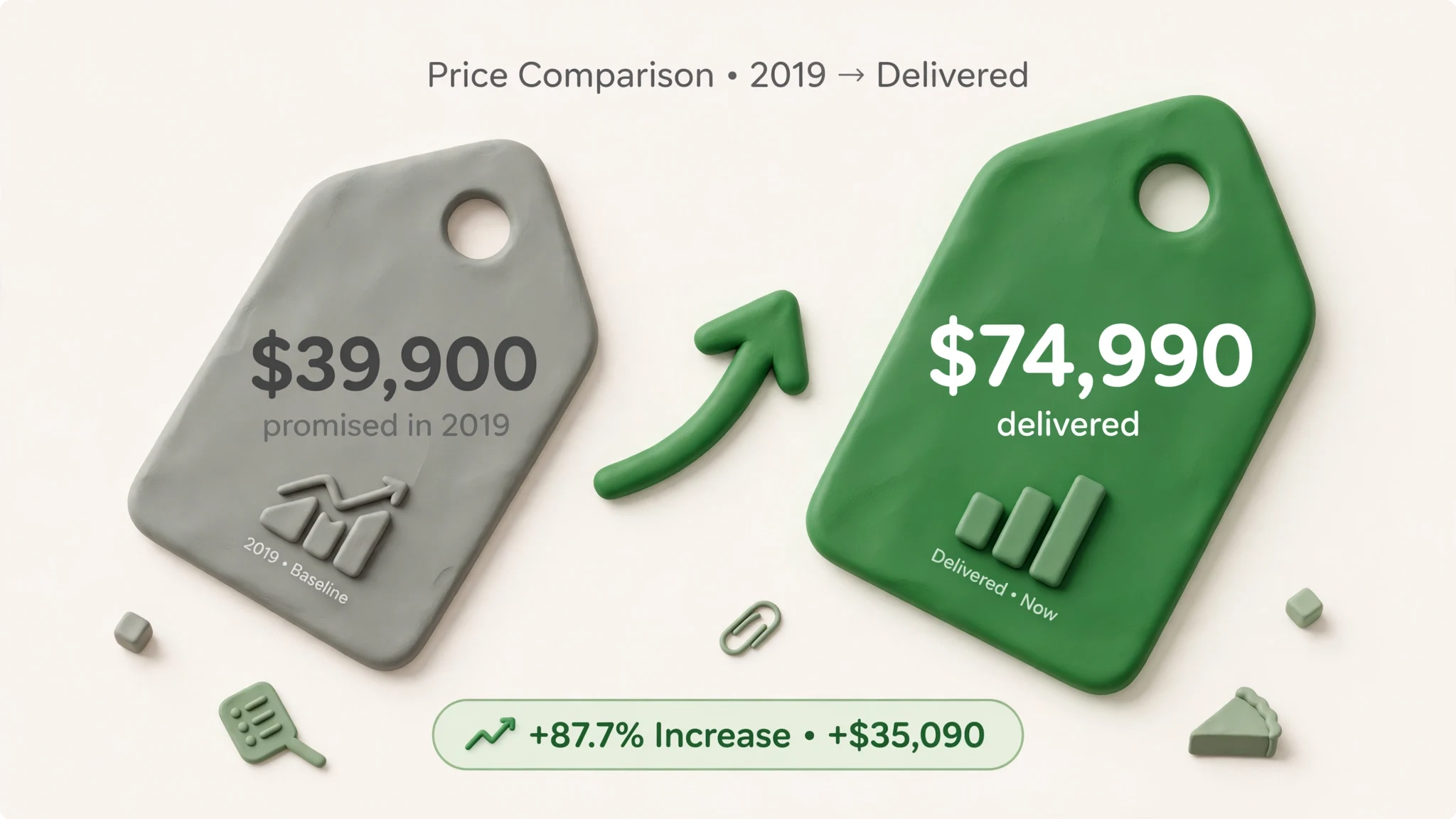
In November 2019, Tesla put a number on the Cybertruck: $39,900. It was a striking number — an electric pickup, radical in every way, for less than the price of a well-equipped conventional truck — and it did much of the work of selling the reservation. Seven years later, the truck that buyers could actually order started at $74,990 for the dual-motor version, with the premium version at $84,990 and the Cyberbeast at $99,990. The gap between the promised price and the delivered price is roughly 88 percent, and it became one of the most repeated facts in every piece of coverage the Cybertruck received.
That gap is the third lesson, and it is about trust rather than arithmetic. A launch price is not a detail. It is a promise, and it is the promise that the earliest and most enthusiastic customers remember most clearly. When the number you launch with and the number you charge differ by nearly double, customers do not hear an explanation about costs, timelines, or market conditions. They hear a broken promise, and they tell each other about it. Every review, every comparison, every discussion of the Cybertruck’s value started from the same place: it was supposed to cost $39,900, and it costs $74,990. The price became the story, and the story crowded out everything else the truck could offer.
Small businesses break the same promise in smaller, quieter ways. A “starting at” price that no customer ever actually pays. An introductory offer that quietly becomes the permanent price. A quote that grows between the estimate and the invoice. A package advertised at one figure and sold at another once the essential extras are added. Each of these feels like a small commercial decision in the moment, and each of them teaches the customer the same lesson: the number you publish is not the number you mean. Once a customer learns that, every future price you publish is discounted in their head before they even read it.
The discipline is straightforward. Publish only prices you can honour, and if the price has to change, explain the change before the customer discovers it. If your costs have risen, say so, and say what the customer gets for the new figure. If the original price was genuinely an early estimate, label it as one from the start, in the same size type as the number itself. And if you are launching something new, be conservative with the launch price: a price that rises modestly is a detail, while a price that nearly doubles is a betrayal. Tesla had reasons for the Cybertruck’s price — years of delay, new materials, a changed market — and none of those reasons mattered, because the promise had been made in public, in a number, and numbers are remembered. Your prices will be remembered the same way. Make sure the memory flatters you.
4. Zero-Advertising Marketing Works Until It Doesn’t
Tesla is famous for spending virtually nothing on traditional advertising. It has never run television commercials for the Cybertruck, it holds no place in the usual automotive advertising calendar, and in 2020 it dissolved its public relations department entirely, becoming the first major carmaker that does not officially talk to the press. Instead, Tesla relies on the product itself, on its chief executive’s enormous social media following, and on the earned media that follows both. For the Cybertruck’s launch, the strategy worked spectacularly: the reveal generated hundreds of millions of impressions, the reservation book filled without a single paid placement, and the brand stayed at the centre of the automotive conversation for years on a marketing budget that barely existed.
The fourth lesson is that a strategy built entirely on earned attention has a single point of failure: the attention itself. Paid advertising is expensive and unfashionable, but it is also a tap you can turn on. When a product’s novelty fades, when the news cycle moves on, when the founder’s account goes quiet, a business with a paid engine can buy its way back in front of buyers. A business with no paid engine, no dealer network pushing its product, and no campaign to rekindle demand has nothing to turn on.
The Cybertruck’s demand curve tells that story plainly: an enormous launch spike, a backlog that cleared, and then a long, steady decline — 38,965, then 20,237, then a pace heading lower still — with no mechanism in place to reverse it. The marketing that launched the Cybertruck could not sustain the Cybertruck, because it was never designed to. It was designed to create a moment.
Small businesses copy this model more often than they realise. A business that lives on one founder’s social media profile, on one viral format, on one referral relationship, or on one platform’s algorithm is running the same experiment Tesla ran, at the same risk. The channel feels free, and while it works it feels like a permanent advantage. But borrowed attention is rented, not owned, and the landlord can change the terms without notice: an algorithm update, a platform policy change, a founder’s illness, a news cycle that simply moves on. The businesses that survive those moments are the ones that used the good times to build channels nobody can take away — an email list they control, search visibility that compounds, a website that converts, a reputation that travels by word of mouth rather than by feed.
That is why the practical version of this lesson is about balance, not about abandoning social media or earned attention. Use the free channels aggressively — they are genuinely powerful, and the Cybertruck’s launch proves how powerful they can be. But convert a share of the attention they produce into assets you own. Every viral moment should end with an email captured, a search ranking earned, or a customer relationship that does not depend on the platform where it started. Our SEO services for small businesses exist for exactly this reason: being findable when your customers are searching is an asset that keeps working after the moment has passed. Tesla’s Cybertruck launch was one of the great marketing achievements of the decade. Its decline is a reminder that achievements do not compound on their own. Systems do.
5. A Viral Moment Is Not a Marketing System
No discussion of the Cybertruck is complete without the window. At the November 2019 reveal, Tesla’s chief designer struck the driver’s door with a sledgehammer without leaving a mark, and then threw a steel ball at the window to demonstrate its supposedly unbreakable glass. The glass cracked. Musk, caught by surprise on stage, tried the second window. It cracked too. Within hours the footage was everywhere, the memes were everywhere, and the Cybertruck — a vehicle most people had never heard of that morning — was the most discussed product on the planet. Tesla, to its credit, did not hide from the moment: it sold t-shirts printed with the cracked-glass pattern and let the joke run for weeks.
The fifth lesson is that a viral moment and a marketing system are two different things, and confusing them is expensive. The cracked glass generated hundreds of millions of impressions, and impressions at that scale are worth real money — the equivalent reach in paid advertising would have cost tens of millions. But impressions are not a funnel. The reveal sold reservations, which, as the first lesson showed, were not demand. What it did not build was a repeatable system for turning attention into buyers month after month: no sustained campaign, no dealer push, no retargeting engine, no content programme that kept the truck in front of the people most likely to buy one. When the memes faded, the attention faded with them, and there was nothing underneath to catch the buyers who had noticed the Cybertruck once and then forgotten it.
For a small business, the equivalent moment is easy to recognise: the post that takes off, the video that gets shared, the mention in a large account, the day the phone rings more than usual. The mistake is to treat that day as the marketing working, rather than as a test of whether the marketing works. The test has a simple form. When the spike arrived, did you capture anything durable from it? Did the visitors join your email list, or did they bounce? Did they search for you again later, or did they vanish? Did the attention turn into enquiries that converted, or into likes that evaporated? If the answers are mostly no, then the viral moment was entertainment, not marketing, and the next one will be the same.
The fix is to build the capture mechanism before the moment arrives, not after it. A landing page ready for a surge. An email capture that offers something worth exchanging an address for. A follow-up sequence that speaks to the people who arrived in the spike. A piece of content that answers the questions the spike raised, published while the surge is still active. We broke down exactly this playbook in our stock market surge newsjacking lessons, where a market rally sent searches soaring and the businesses that published quickly captured the audience at its peak. The Cybertruck’s reveal was the biggest earned-media moment a product launch has produced in years. It still was not enough, because nobody built the system underneath it. Your viral moment will not be enough either, unless the system is waiting.
6. Know When to Kill a Product
The wind-down announcement is, in one sense, the most impressive marketing decision in the whole Cybertruck story — not because ending a product is impressive, but because ending it clearly, publicly, and on a stated rationale is a discipline most businesses never develop. Factory floor is finite. Every Cybertruck built in Austin occupies space, tooling, and attention that a Cybercab could use instead, and Tesla has decided that the future bet is worth more than the present product. That is a hard call to make after years of investment in specialised presses, custom tooling, and a production line built for 250,000 trucks a year. The sunk cost is enormous. The decision ignores it anyway, which is exactly right.
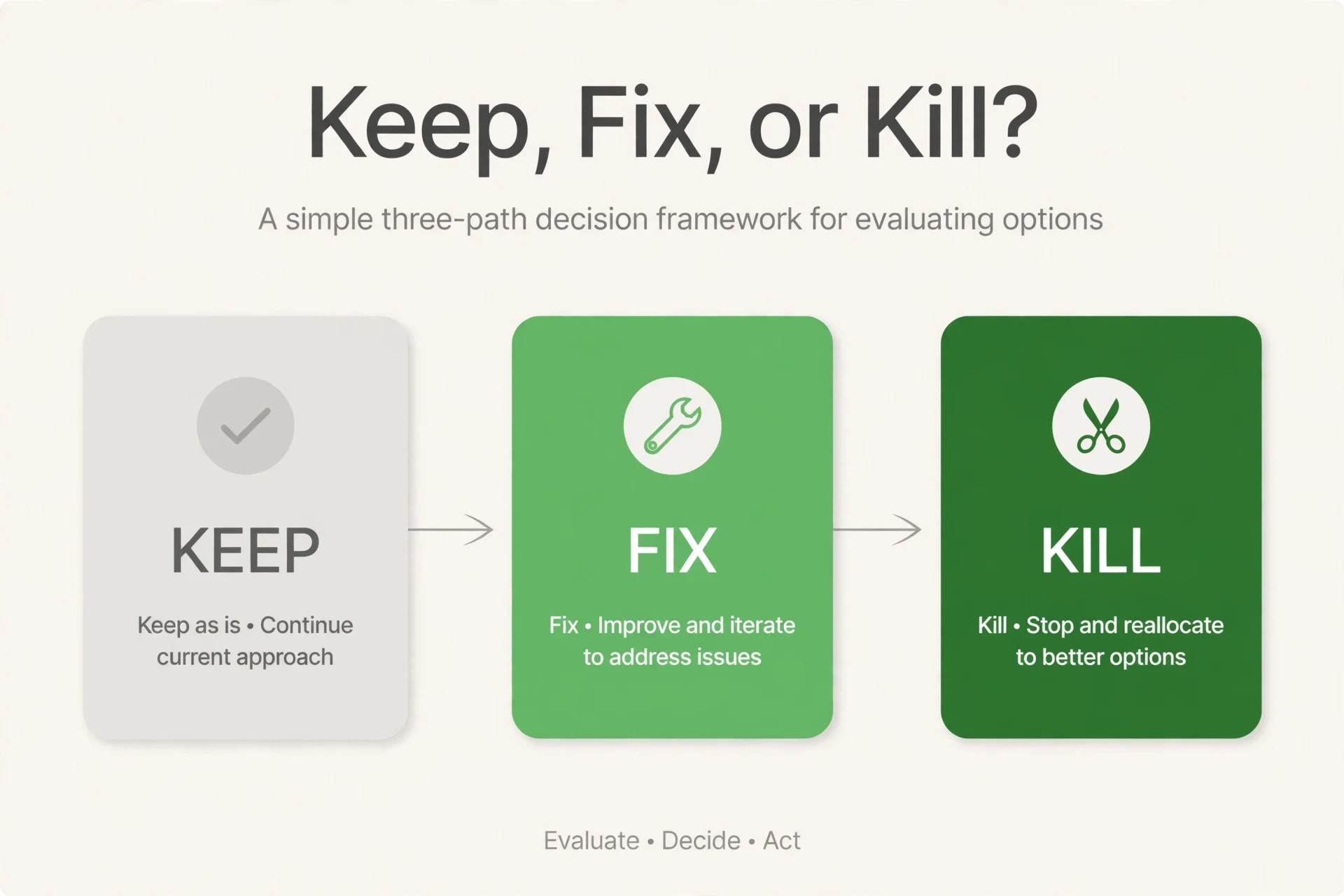
The sixth lesson is the discipline of the kill. Every business accumulates products, services, campaigns, and channels that once made sense and no longer do: the service that sells occasionally but consumes disproportionate time, the ad campaign that still runs because nobody has looked at its numbers in months, the product line that survives on nostalgia rather than margin, the social platform that absorbs hours and returns nothing. The reason they survive is always the same: the investment already made. Time, money, reputation, and effort already spent feel like reasons to continue, but they are not reasons at all. They are history. The only question that matters is whether the next unit of time, money, or attention earns more where it currently sits or somewhere else.
Tesla’s answer to that question is visible in the announcement itself. The Cybertruck was selling at roughly a tenth of its planned volume, in a factory that could build something else. Keeping it alive would have meant defending a shrinking product with resources a growing one needed. The small business version of the same decision is smaller and quieter, but the maths is identical. Audit your offerings honestly, at least twice a year, and ask of each one: if I were starting today, would I build this? If the answer is no, then the only thing keeping it alive is the cost of what you already spent, and that cost is gone either way. Kill it, and move the resources to the thing you would build instead.
There is a second half to this lesson, about how the ending is handled. Musk announced the wind-down plainly, on his own channel, with the reason attached: the factory floor needs to build Cybercabs. He did not let the news leak, did not dress it as a triumph, and did not pretend the product was thriving.
That honesty is a marketing asset in itself, because customers and observers can tell the difference between a business that faces its numbers and one that hides them. When you retire a service or close a line, say so directly, say why, and say what replaces it. We broke down the same discipline from the other side — what happens when a business closes locations and how to handle it — in our Outback Steakhouse closures local SEO lessons. The businesses that handle an ending well keep the trust that the ending itself puts at risk. The Cybertruck’s exit, handled plainly, preserves more goodwill than a slow, silent fade ever would.
7. The Pivot Is the Story
The final lesson is in the second half of Musk’s sentence. Tesla is not simply winding down the Cybertruck. It is winding down the Cybertruck “to make room for increased Cybercab production.” That framing is doing a great deal of work. It turns an ending into a beginning, a retreat into a redeployment, and a product that did not sell into a factory floor that is needed for something more important. The vehicle taking the Cybertruck’s place is Tesla’s purpose-built robotaxi: a two-seater with no steering wheel, engineered to sell for under $30,000, with deliveries promised by the end of 2026. Whether the Cybercab succeeds is an open question. That it gives Tesla a story to tell about the Cybertruck’s ending is not.
The seventh lesson is that every ending needs a next chapter, and the business that writes it first controls the narrative. A product that simply disappears invites the worst interpretation: failure, retreat, decline. A product that ends because something better is taking its place invites a different reading: focus, evolution, ambition. The facts are the same in both versions. The story is not. Tesla understood that, and the announcement was written accordingly — the Cybertruck’s lead engineer even framed the truck as a technology platform that “lives on through Cybercab,” giving the product a legacy rather than an epitaph. That is not spin. It is the truth, told in the order that serves the future rather than the past.
For a small business, the application is immediate. When you retire a service, replace it with something, and say so in the same breath. When you close a product line, point customers to the better option that replaces it. When you change direction, explain what the change makes possible, not only what it ends. Customers accept endings far more readily when they can see the beginning that follows, and they forgive a business that moves on far more easily than one that simply stops.
The Cybertruck’s ending will be debated for years — whether it was a failure of design, of pricing, of demand, or of timing — but the Cybercab framing ensures that the debate is about Tesla’s future as much as its past. Your endings deserve the same treatment. Write the next chapter before you close the last one, and make sure your customers hear about both at the same time.
What Small Businesses Should Do This Week
The Cybertruck story is not only a case study. It is a live search surge, and the same week it is news is the week it is useful. Here is a short, practical list drawn directly from the seven lessons, in the order that matters most.
First, audit the gap between your attention and your demand. Pull the numbers for your last launch, campaign, or viral moment: how many people noticed, how many enquired, how many paid. If the conversion rate surprises you, the problem is not the size of your audience. It is the distance between noticing and buying, and that distance is where your marketing work belongs. Shorten it with a clearer offer, a simpler next step, or a reason to act now rather than later.
Second, check your prices against your promises. Look at every price you have published — on your website, in your proposals, in your social posts — and ask whether the number a customer actually pays matches the number they were first shown. If it does not, fix the published number or explain the difference before the customer finds it. The tax brackets 2027 announcement taught the same timing lesson from the other direction: the businesses that published clear, accurate explainers while the surge was active captured the audience, as we explored in our tax brackets 2027 smart moves for small business owners. Accuracy while attention is high is worth more than perfection after it has gone.
Third, map your attention sources and count them honestly. How many channels bring you customers? If the answer is one — one platform, one person’s profile, one referral source — then your marketing has a single point of failure, and the Cybertruck’s decline is your warning. Use the quiet weeks to build a second and third channel, starting with the ones you own: search visibility, email, and a website that converts. That is slow work, and it is the work that survives a bad month.
Fourth, pick one thing to kill. Look at your services, your campaigns, and your content, and find the one that consumes the most effort for the least return. Stop it this week, and move the time it was consuming to the thing with the best return. You will feel the loss of the familiar more than the gain of the new, and that feeling is the sunk-cost fallacy doing its work. Ignore it.
Fifth, ride the surge while it is still active. The Cybertruck story is live right now: searches are elevated, the questions are open, and the audience is still forming its opinions. Publish something useful about it — a take, a comparison, a lesson for your own customers — and publish it today, not next week. The window for a surge is measured in days, and the businesses that publish while the audience is still searching are the ones that get found. That is the newsjacking play in its simplest form: be useful, be accurate, and be early.
The Cybertruck’s Real Legacy
The Cybertruck will be remembered as one of the boldest product launches ever attempted: a vehicle that looked like the future, generated a million reservations without a dollar of traditional advertising, and turned a broken window into a global moment. It will also be remembered as a reminder that marketing can create demand it cannot sustain, that a promise made in public is remembered in public, and that the most honest decision a business can make is sometimes to stop. Both memories are correct, and both are useful.
For a small business owner, the Cybertruck’s story is not a warning against boldness. Boldness is what made the launch extraordinary, and a version of that boldness — a distinctive product, a memorable moment, a clear point of view — is exactly what most small businesses need more of. The warning is against mistaking the launch for the business. A launch is a moment. A business is a system: prices that match promises, attention that converts to demand, channels that survive a bad month, and the discipline to stop what is not working and put the resources where they earn their keep. Build the system, and the moments will serve it. Build only the moments, and you will eventually discover what Tesla discovered this week: that attention, however spectacular, is not a business model.
If you want help building the system — search visibility that compounds, content that converts attention into enquiries, and a marketing plan that survives the moments it creates — talk to KKeyQik. We help small businesses turn attention into revenue, and we would be glad to help you do the same.
Sources: Electrek’s report on the Cybertruck wind-down and Carscoops’ coverage of the announcement.
Frequently Asked Questions
Yes. On November 6, 2026, Elon Musk announced that Tesla will wind down Cybertruck production at Gigafactory Texas around the middle of 2027, to make room for increased Cybercab production. What is not confirmed is whether production stops entirely or moves elsewhere, and no final build date has been announced, so the careful reading is that the programme is ending at its only factory in mid-2027.
Sales fell far short of the plan. The line was built for 250,000 trucks a year, yet the truck was selling at roughly a tenth of that volume, with United States sales falling year on year. With the backlog of early reservation holders cleared, underlying demand proved much smaller than the reservation count suggested, and the factory floor is now more valuable building Cybercabs.
Tesla does not report Cybertruck sales separately, so the best picture comes from industry estimates. Kelley Blue Book puts United States sales at 38,965 in 2024, 20,237 in 2025, and 11,586 across the first nine months of 2026. Added together, that is roughly 70,000 trucks sold in the United States over nearly three years.
Support continues. The Cybertruck's lead engineer, Wes Morrill, confirmed that Tesla will maintain spare parts and that service will continue for existing owners. A production wind-down ends the building of new trucks; it does not end the servicing of the ones already on the road.
The Cybercab is Tesla's purpose-built autonomous robotaxi, a two-seater with no steering wheel, designed for driverless ride-hailing. It takes over the Gigafactory Texas floor because Tesla sees its future in autonomous transport rather than in a niche pickup. The Cybertruck's engineering, according to its lead engineer, lives on through the Cybercab programme.
A reservation measured curiosity, not intent. Reserving a Cybertruck cost almost nothing, committed the buyer to nothing, and could be cancelled at any time. The truck that eventually arrived also cost far more than the one announced in 2019, and its radical design appealed to a much smaller group of buyers than the reservation count implied. A million names on a list is attention; the sales figures are demand.
Seven, in brief: attention is not demand; a polarising product narrows your market; your launch price is a promise; zero-advertising marketing works until it doesn't; a viral moment is not a marketing system; know when to kill a product; and every ending needs a next chapter. Each one applies at small-business scale, where the same forces decide whether a launch succeeds or fades.
Virtually nothing on traditional advertising. Tesla has never run television commercials for the truck, and in 2020 it dissolved its public relations department entirely. The launch relied on the product itself, on staged reveal events, and on the chief executive's social media presence, which together generated enormous earned media. The strategy produced a spectacular launch but left no paid engine to sustain demand once the novelty faded.
There is no evidence it was staged. During the live demonstration, a steel ball thrown at the window cracked the supposedly unbreakable glass, twice, in front of a global audience. Tesla turned the mishap into merchandise, selling t-shirts printed with the cracked-glass pattern, and the moment generated hundreds of millions of impressions. Whether accident or not, it became one of the most effective earned-media moments in product-launch history.
Yes, while searches are still elevated. The playbook is the same as for any news surge: publish something accurate and genuinely useful while the audience is still searching, capture contact details from the visitors it brings, and connect the topic to a service you actually offer. The window is measured in days, so speed matters — but accuracy matters more, because a wrong figure in a fast-moving story is remembered far longer than a slow post.