


On Wednesday, November 5, 2026, millions of Americans did something they had not done in months: they opened Google and typed “stock market”. Not “best stocks to buy” or a single ticker symbol, but the broad, plain phrase itself — “stock market” — more than 100,000 times, doubling in a single day. “Stock market today” did the same. So did “Nasdaq”, “Dow Jones”, and a long tail of individual stock names from Nvidia to Meta. The stock market surge was not just a story on the financial pages. It was a search event, and search events are where small business marketing is won and lost.
The numbers behind the day explain the attention. The Dow Jones Industrial Average climbed 1,569.40 points, or 3.03 percent, to close at 53,356.12 — its strongest single session since April 2025. The S&P 500 gained 1.58 percent to 7,688.62, and the Nasdaq Composite rose 1.44 percent to 25,736.51. Oil prices plunged more than 8 percent in the same session, and Treasury yields fell. For one afternoon, the market was the loudest story in the country, and the search box was where the country went to understand it.
This post is not a market commentary, and it will not tell you what to buy or sell. It is a marketing breakdown. The stock market surge is a textbook example of newsjacking — the discipline of turning a breaking news moment into useful, timely content before the moment passes. Done well, it puts a small business in front of an audience that is actively searching, at the exact hour that audience is largest. Done badly, it looks opportunistic, off-topic, or worse. Below is what actually happened, why the searches exploded, and seven practical newsjacking lessons any small business can use the next time a surge arrives — in any industry, not just finance.
What Actually Happened in the Stock Market Surge
The rally had a clear trigger. On Tuesday, November 3, 2026, Americans voted in the midterm elections, and the Democratic Party swept to control of both the House of Representatives and the Senate — a result that caught much of Wall Street by surprise. When markets opened on Wednesday, investors reacted to the prospect of a divided government: a Congress that could constrain major policy changes for the remainder of the presidential term, and a White House that might now face real checks on its agenda.
The logic investors were pricing in was straightforward. A divided Washington tends to mean fewer sweeping policy shocks, and markets have historically rewarded that stability. “Gridlock is the market’s friend,” Mark Hackett, chief market strategist at Nationwide, told reporters as the rally built. The pattern has a long history behind it: since 1946, the S&P 500 has returned 19.9 percent on average in the 12 months following a midterm election, according to an analysis by the investment firm Glenmede.
Investors were also betting that a new Congress would increase pressure for a diplomatic resolution to the conflict in West Asia, which had been pushing oil prices higher for months and feeding inflation. Brent crude fell 8.7 percent to $94.62 a barrel on Wednesday, while US crude dropped 8.3 percent to $88.12 — a move that eased one of the biggest worries hanging over consumers and businesses alike.
The gains were broad rather than narrow. Economically sensitive stocks led the way as investors rotated beyond technology: Walmart climbed 4 percent and Bank of America rose 3 percent. The large technology platforms also advanced, with Amazon, Meta Platforms, and Alphabet all higher on the day. At the same time, the rally was not indiscriminate. Shares of data centre operators fell as investors reassessed the regulatory outlook for artificial intelligence infrastructure under a divided government — a reminder that even the biggest surge creates winners and losers, and that the details matter more than the headline.
For a marketer, the most important fact about the stock market surge is not the size of the Dow’s move. It is the speed of the search response. Google Trends showed “stock market” and “stock market today” each passing 100,000 searches and doubling within hours, with “Nasdaq” at the same volume and “Dow Jones” above 50,000. Dozens of individual tickers — Nvidia, Meta, Amazon, Tesla, Apple, Microsoft, Palantir — all surged simultaneously. When a story moves that fast, the audience does not wait for the evening news or the next morning’s paper. It searches, and it searches now.
Why Millions Suddenly Searched “Stock Market”
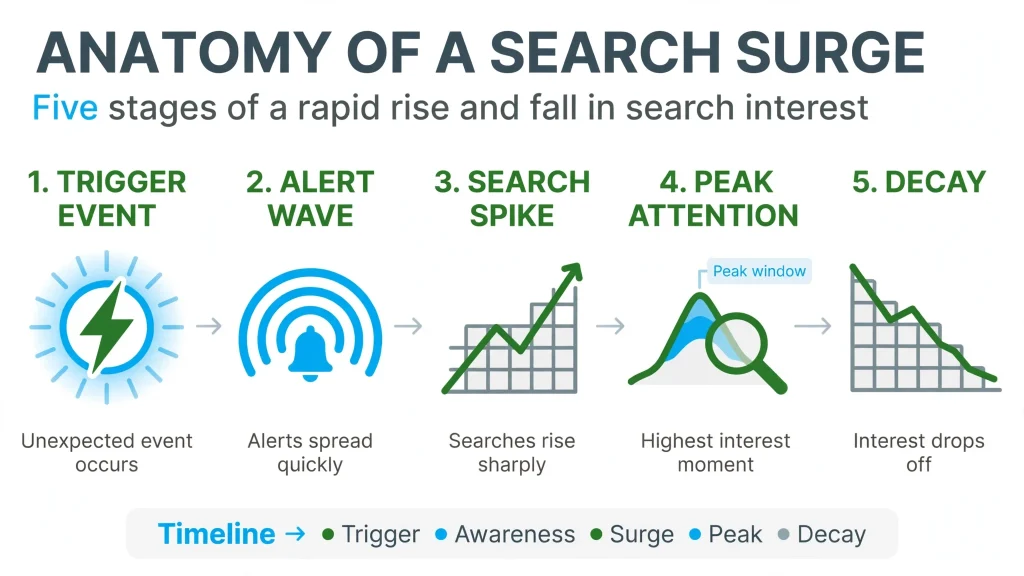
To understand the opportunity, it helps to understand what a search surge actually is. A surge is not simply a popular topic. It is a sudden, measurable spike in demand for answers, concentrated in a window of hours. Three forces combined to create this one.
First, uncertainty. Most people do not follow the market daily, and many hold retirement savings or investments they rarely think about. A headline about the Dow’s best day in 18 months creates an immediate personal question: what does this mean for me? Search is the fastest way to answer a personal question, so the curious, the worried, and the opportunistic all arrive at the same box at the same time.
Second, novelty. The midterm result was unexpected enough to change the story. Markets had spent weeks jittery about the election’s effect on the fiscal outlook, AI regulation, and the war — and then the outcome resolved a large part of that uncertainty in a single night. New information is the fuel of every search surge. People search when something they thought they understood has just changed.
Third, amplification. Financial news travels through push alerts, social feeds, group chats, and workplace conversations within minutes. Each alert sends a fresh wave of searchers to Google, and each wave makes the trend more visible, which draws in the next wave. This is the flywheel that turns a market event into a search event: the story spreads, the searches spike, the spike itself becomes part of the story, and the cycle repeats until attention moves on.
That cycle is exactly what makes a stock market surge — or any surge — so valuable to a marketer. For a few hours, an enormous audience is actively looking for explanations, context, and next steps. The businesses that publish something genuinely useful in that window meet demand at its peak. The ones that wait until the next day are writing for an audience that has already moved on.
What Newsjacking Actually Is
Newsjacking is the practice of inserting a brand into a breaking news story with timely, relevant content — fast enough to ride the wave of attention while it is still building. The term was popularised by the marketing strategist David Meerman Scott, and the classic example remains the Oreo cookie brand’s “You can still dunk in the dark” post during the power cut at the 2013 Super Bowl, published within minutes of the lights going out. The post worked because it was quick, it was relevant to the moment everyone was watching, and it added a small moment of delight rather than a sales pitch.
The discipline has three ingredients, and all three matter. Speed is the first: the value of a newsjacking response decays by the hour, and often by the minute. Relevance is the second: the connection between the news and the brand has to be real, not forced. A bakery has no natural angle on a stock market surge; a financial adviser, a business coach, or a marketing agency explaining the stock market surge as a search phenomenon does. And usefulness is the third: the content has to give the reader something — an explanation, a framework, a checklist — rather than simply repeating the headline with a logo attached.
The stock market surge passes all three tests for a marketing business, which is why this post exists. The stock market surge itself is the subject, the lesson is the product, and the reader walks away with a method they can reuse. That is the standard every newsjacking attempt should meet: if you removed the brand name, would the content still be worth reading? If the answer is yes, the attempt is legitimate. If the answer is no, it is noise.
1. Speed Beats Polish — the Window Is Measured in Hours
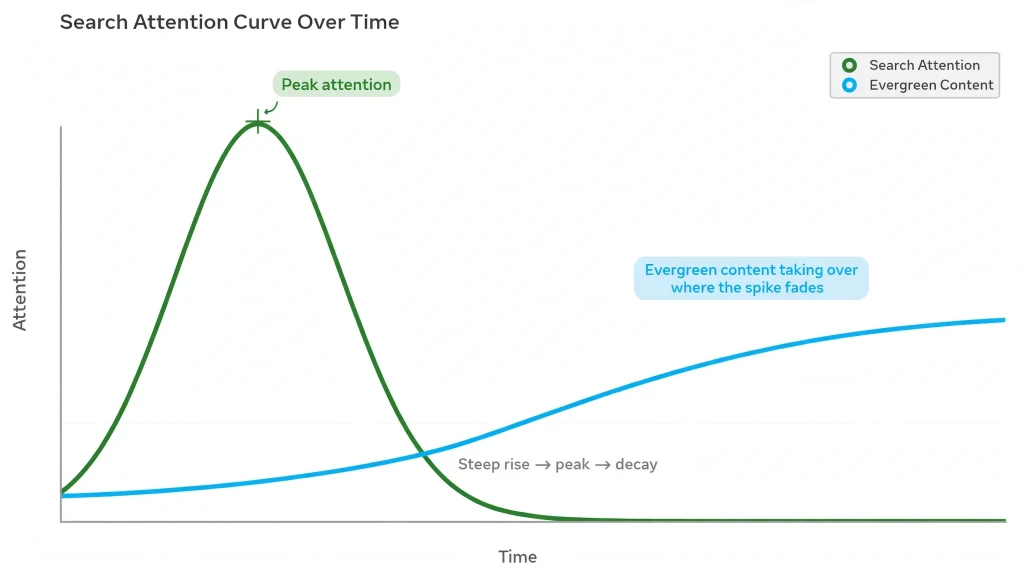
The first lesson of the stock market surge is the one most small businesses get wrong: they wait until the content is perfect, and by then the audience is gone. A search surge follows a predictable curve. It rises sharply in the first two to four hours, peaks while the story dominates the news cycle, and decays within a day. The Dow’s rally was already the biggest story in America by mid-afternoon on Wednesday; by Thursday morning, the conversation had moved on to what the new Congress would actually do next. The searches followed the same arc.
That curve sets the deadline. A newsjacking response that takes 48 hours to approve, design, and publish is not a newsjacking response at all — it is a history lesson. The practical fix is to lower the bar for surge content deliberately. A post about a stock market surge does not need a custom photoshoot, a committee review, or a thousand-word research memo. It needs a clear angle, verified facts, and a publish button. Aim for useful and accurate, not flawless, and reserve the polish for the evergreen follow-up that comes later.
Small businesses can prepare for this in advance. Keep a short list of pre-approved topics where your business has a genuine right to comment — the subjects your customers already ask you about — and a named person who can publish without waiting for a meeting. When the next surge arrives in your world, the decision should take minutes, not days. Speed is not about cutting corners on accuracy; it is about cutting the approval chain that turns a two-hour job into a two-day one.
2. Ride the Wave You Can Actually Surf
Not every surge is yours. The stock market surge carried dozens of trending tickers, but a business that sells handmade soap has no credible angle on Nvidia’s share price, and pretending otherwise damages trust faster than silence does. The second lesson is a relevance filter: before you write a word, ask whether the stock market surge connects to something your business genuinely knows or does.
The test is simple. Could a customer reasonably ask you about this topic? A marketing agency can explain a search surge because attention is its trade. A financial planner can explain a market rally because portfolios are theirs. A restaurant cannot, and should not try — but the same restaurant could legitimately newsjack a local food festival, a new farmers’ market, or a viral recipe trend, because those surges sit inside its world. Relevance is not about the size of the trend. It is about the fit between the trend and the business.
This filter also protects the brand. Readers can tell the difference between a business adding value to a story and a business stapling its logo to one. The first earns attention; the second earns eye-rolls, and in a feed full of opportunistic posts, the eye-roll is the more common outcome. The stock market surge rewarded the businesses that could explain it. Every surge has its natural explainers, and the smart move is to wait for the one that is yours.
3. Lead With the Angle, Not the News
By the time a small business publishes, the news itself is already everywhere. Repeating that the Dow rose 1,569 points adds nothing — every news outlet has already said it, faster and with more authority. The third lesson is that the angle is the content. Readers do not come to a small business blog for the headline. They come for the interpretation: what it means, what to do about it, and what to watch next.
In this post, the angle is the marketing lesson hidden inside the market story. The stock market surge is the hook; the seven lessons are the payload. The same structure works in any industry. A bakery newsjacking a viral baking trend should not report that the trend exists — it should teach the technique, share the recipe adaptation, or explain why the method works. A gym newsjacking a fitness challenge should not announce the challenge — it should publish the safe way to attempt it. The news gets the click. The angle earns the read, the share, and the return visit.
Finding the angle takes one question: what does my customer need to know that the news coverage is not telling them? News outlets report what happened. A business can report what it means for a specific person in a specific situation — and that specificity is exactly what search engines reward, because it matches the long, specific queries real people type.
4. Never Fake Expertise — Especially With Money
The fourth lesson is a guardrail, and it matters most on a finance story. A stock market surge tempts every business to sound like an analyst, and that is precisely where small businesses get into trouble. Financial advice is regulated, readers act on it, and a confident-sounding prediction from a non-expert can cost someone real money. The rule is simple: stay inside your own expertise, and say so plainly.
This post does that by design. It explains the marketing phenomenon — the search surge, the attention cycle, the newsjacking method — and it deliberately avoids telling anyone what to do with their investments. The market facts are reported and sourced; the advice is about marketing, not money. That boundary is not a limitation. It is what makes the content trustworthy, and trust is the asset a small business is actually building.
The same guardrail applies to every surge. A health trend is not an invitation to give medical advice. A legal story is not an invitation to interpret the law. A product recall is not an invitation to speculate about safety. The businesses that last are the ones that know where their expertise ends and say so. Readers respect that honesty far more than they respect a confident guess, and search engines increasingly do too — content that overreaches its authority is exactly the kind that loses visibility over time.
5. Turn One Surge Into a System
The businesses that benefit most from a stock market surge are not the ones that got lucky once. They are the ones that treat surges as a repeatable system. The fifth lesson is to build a small, durable radar for attention spikes in your industry, so the next surge finds you ready instead of surprised.
The system is simpler than it sounds. Start with Google Trends itself: the “Trending Now” page for the United States, filtered to active trends, shows what Americans are searching for right now, updated through the day. A five-minute check each morning reveals the spikes before they peak. Add Google Alerts for the handful of topics that matter to your business — your industry, your city, your main product category — so the alert arrives while the stock market surge is still building. Follow the trade publications and local news sources that break stories in your field, and watch what your customers are sharing, because a stock market surge your customers care about is a surge worth joining.
Then make the workflow boring. A one-page checklist that says who writes, who approves, who publishes, and where the post goes will do more than any tool subscription. The goal is to shrink the gap between spotting a surge and publishing a response from days to hours. The stock market surge rewarded speed; the next surge in your industry will do the same, and the businesses with a system will be the ones that catch it. If you want help building that kind of always-on visibility, our SEO services for small businesses are designed around exactly this: being findable at the moment your customers are searching.
6. Amplify Across Every Channel at Once
A surge post that sits quietly on a blog is a missed opportunity. The sixth lesson is that a search surge is a multi-channel moment: the same audience that is searching on Google is also scrolling social feeds, checking email, and talking in group chats. The businesses that win a stock market surge meet the audience in all of those places, at the same time, with the same angle adapted to each format.
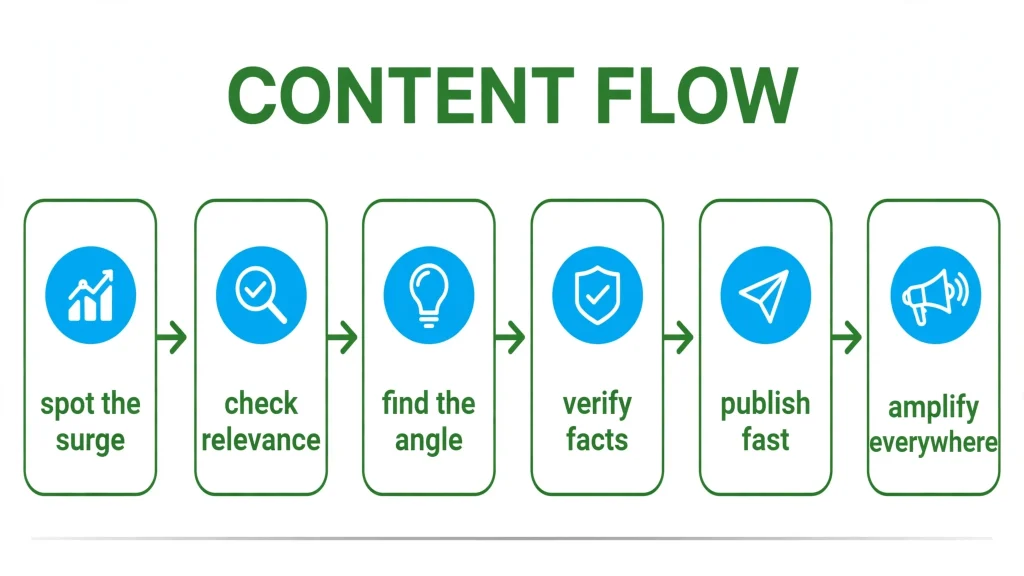
The order matters. Publish the blog post first, because search is where the demand is concentrated and a blog post is the asset that keeps earning traffic after the surge fades. Then cut it into social posts — one sharp takeaway per post, not a link dump — and share the most surprising fact or the most useful lesson, not the headline. Then send it to the email list with a subject line that names the stock market surge, because subscribers who missed the news will open an email that explains it. Each channel feeds the others: social shares drive early traffic that helps the post rank, and the ranking drives the search traffic that keeps working for weeks.
This is also where a small business has an edge over a large one. A large brand needs approvals across departments; a small business can publish, post, and email within the hour. That agility is the whole advantage, and it disappears the moment the process gets heavy. Keep the amplification simple — one post, three social cuts, one email — and do it while the stock market surge is still active. For a closer look at how real-time content fits into a wider visibility plan, see our earlier breakdown of the election search surge, where the same multi-channel pattern played out two days earlier.
7. Bank the Evergreen Follow-Up
Every surge decays. By the end of the week, “stock market” searches will be back near normal, and a post that only reports the stock market surge will stop earning traffic. The seventh lesson is to convert the temporary spike into a permanent asset: the evergreen follow-up. A stock market surge post captures the moment; a follow-up captures the readers the moment brought in.
The follow-up is a slower, deeper piece built from the same material. In this case, that might be a guide to newsjacking for small businesses, a checklist for riding Google Trends, or a case study of how a stock market surge behaves from spike to fade. The surge post links to it, the follow-up links back, and together they turn a one-day spike into a durable search asset that ranks for the broader topic long after the news cycle ends.
This is also the lesson that compounds. Each surge a business covers adds one timely post and one evergreen asset to its library, and the library is what builds authority over time. The Outback Steakhouse closures taught the same pattern from a different angle — a local search surge that rewarded the businesses which published clear answers quickly, as we covered in our local SEO lessons from the closures. The mechanism is identical whether the surge is a market rally, a restaurant closure, or a viral phrase like the one we broke down in our Habibi viral phrase marketing lessons. Surges differ; the system does not.
The Other Surge That Same Morning: Powerball
The stock market surge was not the only attention spike on November 5 — and that matters, because surges compete with each other. On the same morning, a single ticket sold in New Jersey won the $847 million Powerball jackpot, the ninth-largest prize in the game’s history, with a cash value of $363.1 million. The winning numbers were 15, 34, 41, 53, and 56, with a Powerball of 21. “Powerball” searches passed 200,000, and “powerball numbers” passed 100,000 — bigger, in raw volume, than the market terms.
The jackpot story is a masterclass in a different marketing mechanism: scarcity and dream-selling. A jackpot that grows for two months without a winner creates urgency with every drawing, and the reset to $20 million for the next drawing on Saturday, November 7, starts the cycle again. Nobody needs a lottery ticket; millions buy one because the prize makes the dream vivid and the deadline makes it urgent. Small businesses use the same two levers constantly — limited-time offers, seasonal drops, countdown timers — and the Powerball cycle shows why they work: a big, vivid reward plus a hard deadline is the most reliable attention engine ever built.
The practical point for marketers is about choosing battles. Two surges on one morning means attention is split, and a business cannot ride both. The stock market surge belonged to businesses that could explain markets or attention; the Powerball surge belonged to nobody in particular, which is why most of its coverage was pure news rather than marketing. Picking the stock market surge you can genuinely add value to — and letting the other one go — is a discipline, not a missed opportunity.
A Simple Newsjacking Playbook for Your Business
Pulling the lessons together, here is the playbook in one place. Print it, pin it, and use it the next time a surge appears in your world.
Spot it early. Check Google Trends for the United States each morning, filtered to active trends. Set Google Alerts for your industry, your city, and your product category. Watch what your customers are sharing before the news outlets catch up.
Filter for fit. Ask whether a customer could reasonably ask you about this topic. If the honest answer is no, let the stock market surge pass. Relevance is a moat, not a constraint.
Find the angle. Do not repeat the news. Ask what your customer needs to know that the coverage is not telling them — the explanation, the implication, the next step, the method.
Verify before you publish. Check the key facts against two sources. Get the numbers right, name them plainly, and link to the source. A stock market surge post with a wrong number is worse than no post at all.
Publish fast, then polish. Ship the useful version within hours. Update it later with better data, a cleaner chart, or a sharper headline. Search engines and readers both reward the page that was there first and stayed accurate.
Amplify everywhere at once. Blog first, then social cuts, then email — all in the same window, all carrying the same angle.
Build the evergreen follow-up. Turn the surge post into a durable guide within the week, link the two together, and let the temporary spike fund a permanent asset.
What Not to Do When a Surge Hits
The mistakes are as instructive as the lessons. Do not publish before verifying the facts — an early post with a wrong number spreads faster than the correction. Do not force a connection that is not there; readers spot a stapled-on logo instantly, and the brand damage outlasts the stock market surge. Do not turn a serious event into a joke, and do not use a tragedy, a disaster, or someone’s misfortune as a marketing hook — some surges are for watching, not riding. Do not give advice outside your expertise, especially about money, health, or law.
And do not measure success by the spike alone: a surge post that brings ten thousand visitors and zero enquiries is a vanity metric. What matters is not how many people arrive, but whether the people who arrive are ready to act.
The Stock Market Surge Fades. The System Stays.
The stock market surge of November 5, 2026, will be a footnote within weeks. The Dow’s best day in 18 months, the oil plunge, the midterm sweep — all of it will be absorbed into the longer story of a volatile year. What will not fade is the pattern it demonstrated. Attention now arrives in surges, it concentrates in search, and it rewards the businesses that are ready with something useful while the window is open.
That readiness is not a talent. It is a system: a morning check of what is trending, a filter for what fits, an angle that adds value, facts that check out, and a publish button that does not need a meeting. Build it once, and every surge — a market rally, a closure, a viral phrase, a jackpot — becomes an opportunity instead of a scramble. The next surge in your industry is already forming. The only question is whether you will be watching when it breaks.
If you want a marketing partner that watches the trends, moves fast, and turns attention into enquiries, talk to KKeyQik — or explore our SEO services for small businesses, social media marketing services, and video marketing services for small businesses to see how we keep brands visible at the exact moment their customers are searching. The stock market surge is the opportunity. The system is the advantage.
Frequently Asked Questions
The rally followed the Democratic Party's sweep of both the House of Representatives and the Senate in the US midterm elections on November 3, 2026. Investors reacted to the prospect of a divided government constraining major policy changes, and to hopes that a new Congress would press for a diplomatic resolution to the conflict in West Asia. Oil prices fell more than 8 percent in the same session, which eased inflation worries and added to the positive mood.
The Dow Jones Industrial Average climbed 1,569.40 points, or 3.03 percent, to close at 53,356.12 on Wednesday, November 5, 2026 — its strongest single session since April 2025. The S&P 500 gained 1.58 percent to 7,688.62 and the Nasdaq Composite rose 1.44 percent to 25,736.51. Economically sensitive stocks led the gains, with Walmart up 4 percent and Bank of America up 3 percent.
Newsjacking is the practice of inserting a brand into a breaking news story with timely, relevant content, fast enough to ride the wave of attention while it is still building. The term was popularised by marketing strategist David Meerman Scott. It works when three ingredients are present: speed, a genuine connection between the news and the brand, and content that gives the reader something useful rather than simply repeating the headline.
Within hours, not days. A search surge typically rises sharply in the first two to four hours, peaks while the story dominates the news cycle, and decays within a day. A response that takes 48 hours to approve and publish arrives after the audience has moved on. The practical approach is to publish a useful, accurate version quickly and improve it later, rather than waiting for a polished version that misses the window.
Ask whether a customer could reasonably ask you about the topic. A marketing agency can explain a search surge because attention is its trade; a financial planner can explain a market rally because portfolios are theirs. If the honest answer is no, let the surge pass. Readers can tell the difference between a business adding value to a story and a business stapling its logo to one, and the second earns eye-rolls rather than attention.
It can be, if the business strays into giving financial advice. Financial guidance is regulated, and readers act on it, so a confident prediction from a non-expert can cost someone real money. The safe approach is to stay inside your own expertise: explain the marketing phenomenon, the search behaviour, or the business lesson, and leave investment decisions to qualified advisers. Saying plainly where your expertise ends builds trust rather than weakening it.
Newsjacking is one specific form of real-time marketing: reacting to a breaking news story. Real-time marketing is broader and covers any content created in response to something happening now, including viral trends, cultural moments, seasonal events, and live audience behaviour. Every newsjacking attempt is real-time marketing, but not every real-time marketing effort is newsjacking. The two share the same discipline — speed, relevance, and usefulness — applied to different kinds of moments.
Start with Google Trends for the United States, filtered to active trends, checked each morning — it shows what Americans are searching for right now. Add Google Alerts for your industry, your city, and your main product category, so alerts arrive while a surge is still building. Follow the trade publications that break stories in your field, and watch what your own customers are sharing, because a surge your customers care about is a surge worth joining.
It should lead with an angle, not the news: the explanation, the implication, or the method the coverage is not providing. Include verified facts with named sources, a clear framework or checklist the reader can reuse, and a specific next step. If you removed the brand name from the post and it would still be worth reading, the attempt is legitimate. If it would be empty without the logo, it is noise.
By building an evergreen follow-up within the week: a deeper guide, checklist, or case study built from the same material. The surge post captures the moment and links to the follow-up; the follow-up links back and keeps ranking for the broader topic long after the news cycle ends. Each surge a business covers adds one timely post and one durable asset to its library, and that library is what builds search authority over time.