

Updated: October 2026 · By the KKeyQik Team
Hiring design help is a hiring decision, and it deserves the same care you would give any senior hire. The work an agency produces ends up everywhere your customers judge you: your logo, your packaging, your proposals, your ads, your social profiles. When the fit is wrong, the problem rarely shows up in week one. It shows up three months in, when deadlines slip, files arrive in formats your team can’t open, and the finished work looks like it belongs to somebody else’s brand.
Most owners start researching how to choose a graphic design agency only after a disappointing first engagement. A short, structured process prevents that. The steps below define the outcome first, evaluate evidence second, and test the working relationship before anything long-term is agreed. If you want a grounding in what is typically included first, our overview of graphic design services for small business covers the main service types, so you know what you are comparing.
Treat this like hiring, because functionally it is. You are selecting the people who will translate your business into the first thing a prospect sees — often before price, before a conversation, before any chance to explain yourself. That translation either builds trust in the first few seconds or quietly taxes every sale that follows. The seven steps below are ordered deliberately: each one is far easier to get right at its stage than to fix after the next one has built on it.
Key Takeaways
- Choose an agency the way you would make a senior hire: evidence first, chemistry second.
- Relevant, consistent work in your category matters more than a wide-ranging portfolio.
- A clear process — brief, concepts, feedback rounds, file delivery — says more about how a project will run than style alone.
- Agree on deliverable formats and file ownership in writing before work starts.
- Start with one scoped project, judge the fit honestly, and extend only when the evidence supports it.
The 7-Step Checklist
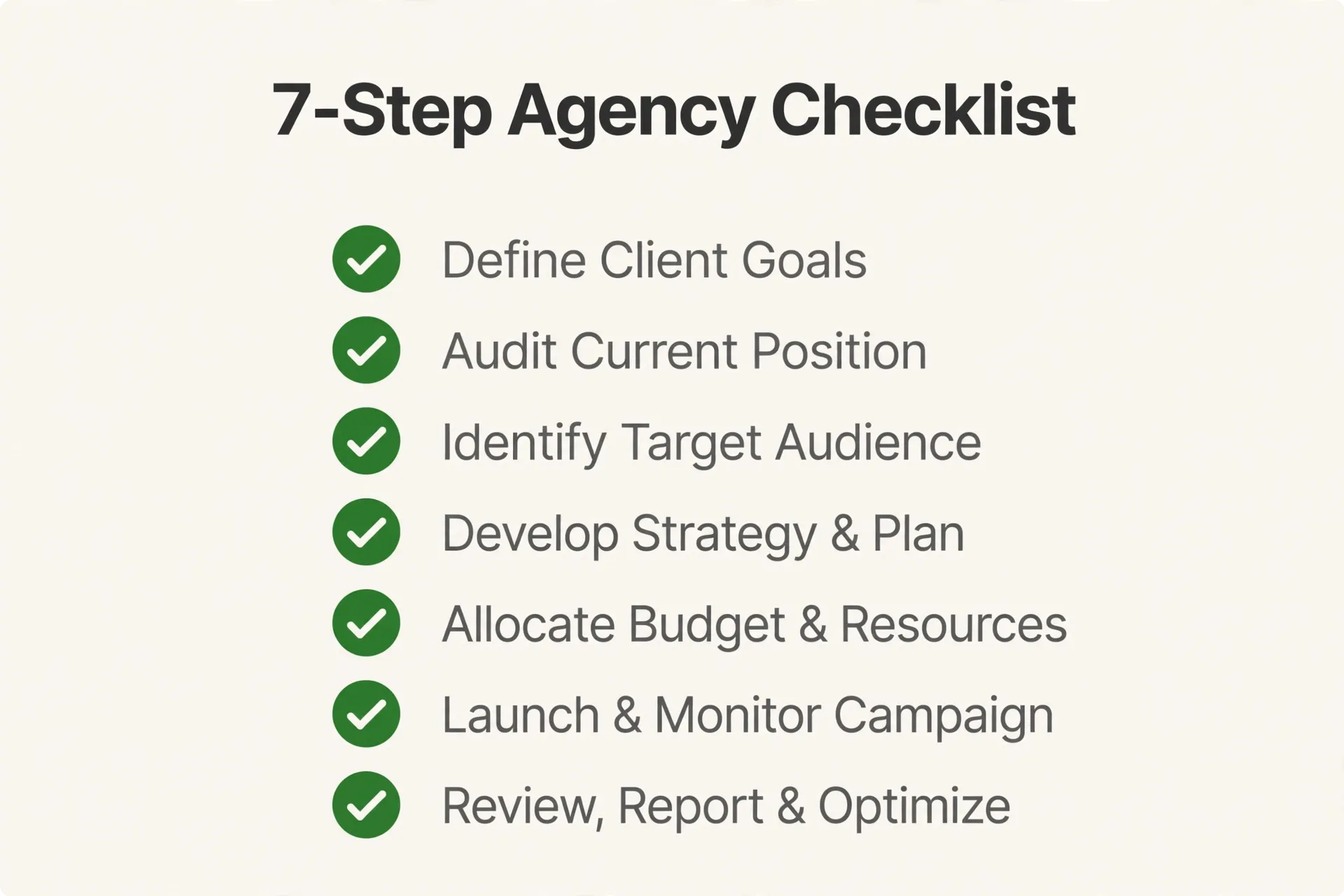
You don’t need a procurement department to run this. You need one focused afternoon, a page of notes, and the discipline to ask the same questions of every candidate. Working through how to choose a graphic design agency this way takes longer than picking from a search results page — and it is what makes the working relationship still function a year later.
1. Define the outcome before you look at portfolios
Design projects go sideways when “make it look better” is the entire brief. Before you contact anyone, write down the business outcome you need: a new identity that reads clearly at favicon size and on signage, marketing materials your sales team can send without apologizing, packaging that survives a retail shelf. Each outcome calls for different skills, and different partners are right for each.
Also decide what happens after delivery. Who uses these files weekly, who updates them, and what “done” means in business terms — proposals that go out faster, decks that support sales conversations, templates your team can update in-house without waiting on a designer for every change.
This single page of notes does real work. It lets the wrong-fit agencies rule themselves out early, and it makes every conversation that follows shorter and sharper.
2. Review portfolios for relevant work, not impressive work
A portfolio is evidence, not entertainment. Look for projects close to your category, your audience, and your channels. A team that’s brilliant at event posters may be slow with a forty-page capabilities deck; a packaging specialist may not enjoy weekly social graphics. Relevance says more about fit than raw talent does.
Pay attention to consistency inside each project: the same brand carried across a logo, a brochure, and a profile header without drifting. Then note what’s missing. If everything is a pristine mockup and nothing appears in the real world — printed, shipped, posted — ask to see work in use.
One more check: ask which projects in the portfolio are current client work and which are concept pieces. Both have value, but they prove different things. Concepts show range and taste; shipped work shows the team can carry a design through real constraints — a client’s legal review, a printer’s limits, a founder’s strong opinions.
3. Test process clarity
Ask every candidate the same question: walk me through a project from first conversation to final files. A team that can describe its process in two minutes — brief, concepts, feedback rounds, delivery — is usually a team that runs it consistently. Vague answers (“we’ll figure it out as we go”) tend to predict vague projects.
Process clarity matters most where projects usually strain: feedback. Who collects your comments, how are versions tracked, and what happens when you dislike a direction entirely? You are not looking for the most elaborate system. You are looking for one that exists, that you can repeat back in your own words, and that keeps you from re-litigating the brief at every round.
4. Check communication and feedback loops
Find out who you actually work with day to day: one named contact, or a rotating inbox? How are questions answered, and within what kind of timeframe? None of this needs to be contractual. It needs to be clear enough that you can plan your own week around it.
The best signal arrives before you sign anything. Clear answers, timelines stated plainly, and questions about your business — rather than only about deliverables — tell you how the engagement will feel in month three. A design relationship that needs daily chasing consumes exactly the hours you hired help to get back.
Decide in advance how you’ll give feedback, too. Written comments in one place, from one person on your side, beat scattered opinions from five stakeholders. Agencies can only run a clean feedback loop if you meet them halfway — and the ones worth hiring will tell you exactly what they need from you to do it.
5. Confirm deliverables and file ownership before work starts
Months from now, this will be the step you’re gladest you took. Ask exactly what you receive at handoff: editable source files, print-ready PDFs, exports sized for web and social, a simple guide for using them. Get the list in writing before work begins. Projects rarely sour over design quality; they sour over discovering at the end that the files you need were never part of the scope.
Ownership deserves the same directness. Who owns the final artwork, who holds the licenses for fonts and stock imagery, and can you take everything to another provider later if you need to? If the project includes a logo, confirm you’ll receive what a trademark filing requires — the U.S. Patent and Trademark Office explains what trademark registration protects and why original, ownable artwork matters. These are normal questions. An agency that handles them comfortably is telling you something good about itself.
6. Look for category understanding
Great design aimed at the wrong audience is still the wrong design. The right partner asks about your customers before showing you their favorite fonts: who buys, what they compare you against, where your materials get seen — a shelf, an inbox, a trade show table. Their questions reveal whether they design for your buyers or for their own portfolio.
A practical test: ask why a past design choice worked for that client’s audience. Strong agencies answer in business terms — readability at distance, shelf standout, consistency across a product line — rather than pointing at trends. Trend fluency is easy to find. Category judgment is the scarcer skill, and it is the one you are actually buying.
7. Start scoped, then review the fit honestly
Don’t open with the biggest project on your list. Open with one defined piece — a capabilities deck, one campaign’s worth of graphics, a packaging refresh for a single product line — and judge the relationship on evidence: communication, quality, deadlines, and how the feedback rounds actually felt.
If it works, extending the relationship is an easy decision, and the agency has earned the bigger brief. If it doesn’t, you learned at small scale and still own usable work. Long-term arrangements should be the conclusion of a good first project, not the precondition for one. Evidence from a real project will always tell you more than any pitch.
What to Look for in a Portfolio
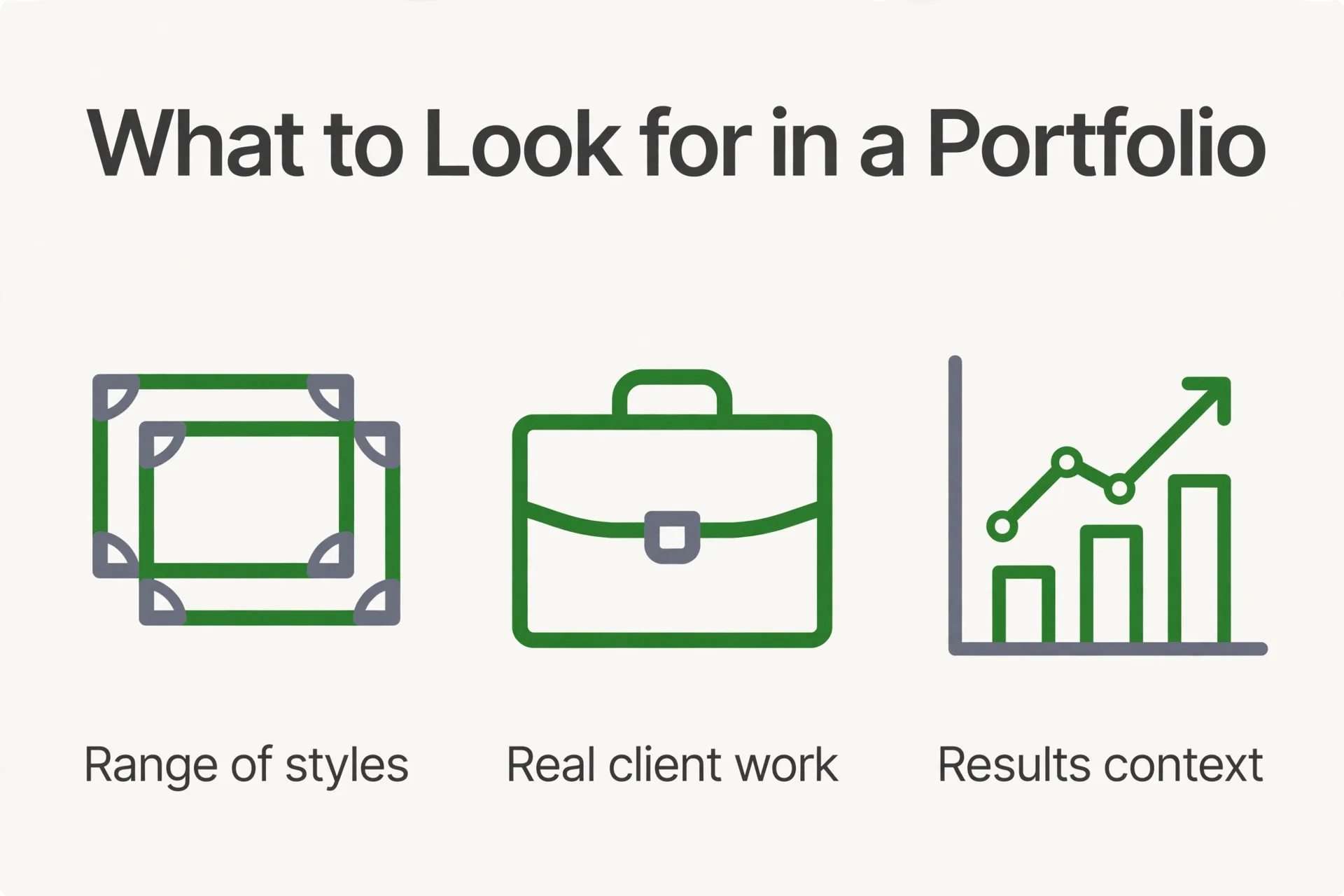
Beyond the checklist, it helps to read a portfolio the way the designer hopes you won’t: critically. Three lenses help.
Relevant depth over range. Twenty unrelated one-off projects show versatility; one brand carried across identity, packaging, print, and social over several years shows the skill your project actually needs — sustained consistency. Most small businesses need the second.
Consistency inside the system. Open three pieces from the same client and compare typography, spacing, and color discipline. Brands rarely fail in the hero piece; they fail in the hundredth small piece, where care slipped. A portfolio that shows the small pieces — the back label, the email header, the size chart — is showing you the discipline you’ll be buying.
Real-world application. Mockups flatter everything. Look for photographs of printed work, screenshots of live pages, packaging on actual shelves. Check the unglamorous fundamentals too: type that stays legible at small sizes, and color combinations that hold up for readers with low vision — the W3C’s WCAG guidance on color contrast is the standard designers work against, and a good portfolio respects it without making a fuss.
One caution: polish can create a halo. Nielsen Norman Group documents how attractive design leads people to judge usability more generously — the aesthetic-usability effect. Enjoy the portfolio, then evaluate it anyway: would this work survive your printer, your shelf, your smallest ad size?
Finally, ask how the portfolio pieces performed their job in the plainest sense. Did the client keep using the identity, extend the packaging line, or roll the templates out to a sales team? Work that survives contact with a real business — budgets, printers, opinionated stakeholders, last-minute size changes — looks slightly different from work made only to be admired. Hire for the first kind.
Questions That Reveal Process Quality
Portfolios show you outcomes. Questions show you the machine that produced them. These six consistently separate established teams from talented improvisers — and professional bodies like AIGA exist largely to codify the standards behind them.
How do you handle revisions, and how many rounds are typical? A confident answer names a structure: defined feedback rounds at the concept stage and again during refinement, with a clear route for extra rounds when you need them. “As many as it takes, forever” sounds generous and usually means the process has no checkpoints — which is how projects drift.
What exactly do we receive at the end, and in what formats? Listen for specifics: source files, print-ready PDFs, web and social exports, brand usage notes. Vagueness here is the single most common source of end-of-project friction.
What do you need from us before starting? Good agencies ask for a lot: your goals, your audience, your existing materials, your constraints. An agency ready to start designing before understanding the business is selling speed, not design.
Who will actually work on our project? Meeting the people who pitch is normal; the question is whether they also design. Either model can work — you just want to know which one you’re in, and who reviews the work before it reaches you.
What does a typical timeline look like, and what stretches it? You’re listening for realism: dependencies named, your own feedback time built in, busy periods admitted. Teams that promise every timeline usually keep none of them.
Can we speak with a client in a similar business? A reference in a comparable category tells you how the agency communicates under deadline pressure — the thing no portfolio can show. Established teams expect the question.
Run the same six questions with every candidate and write the answers down. Side-by-side notes turn vague impressions into comparisons you can act on, and they expose the real differences quickly: one team’s answers will be specific, consistent, and easy to verify. That’s your shortlist telling you who’s who.
Red Flags
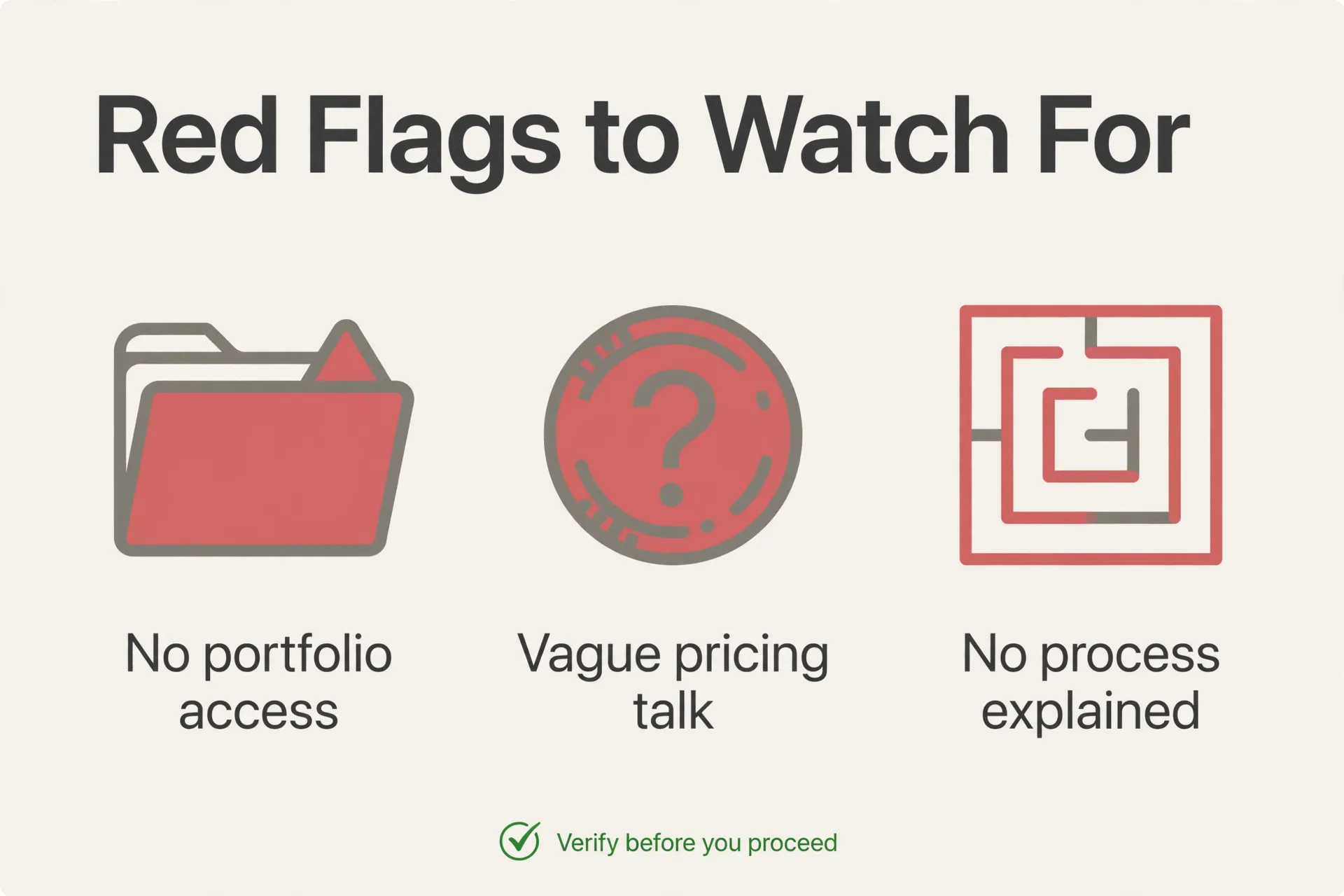
None of these alone disqualifies an agency. Two or three together predict a difficult engagement, and all of them are visible before you commit.
No process they can describe. If the workflow is “send us what you have and we’ll make something,” every decision becomes a negotiation, and you’ll end up doing the project management yourself.
A portfolio built on borrowed styles. Work that closely tracks famous brands or passing templates photographs well and ages badly — and artwork that leans on someone else’s identity can create genuine legal exposure. Original work you own outright is the point of hiring design help in the first place.
Deliverables and ownership stay fuzzy. Reluctance to specify final files, source files, or licensing in writing usually means the handoff is where the surprises live.
Pressure to commit today. Urgency tactics and vague warnings about waiting are sales tools, not design judgment. A team confident in its work can survive your comparison shopping.
Everything is a yes. An agency that agrees with every idea you bring isn’t collaborating; it’s transcribing. You want a partner who pushes back with reasons — respectfully, and in service of the outcome you defined in step one.
None of this requires detective work. Every flag above surfaces in the first couple of conversations, in writing, if you ask the questions in this checklist and listen to how completely they’re answered. Trust the pattern, not the pitch.
Agency vs Freelancer vs In-House: Which Fits
The checklist above applies to all three options. What changes is capacity, continuity, and how much of the managing you do yourself.
| Option | Best for | Watch out for |
|---|---|---|
| Agency | Multiple formats at once — identity, print, digital — with strategy and production in one place | Fit: make sure small-business work is a core client type, not a side line |
| Freelancer | One well-defined skill — packaging, illustration, deck design — delivered directly by the person you hired | Availability and continuity: illness, holidays, and a full book all land on your timeline |
| In-house hire | Steady daily design volume that justifies a full-time seat | You become the art director: briefs, quality control, and cover during leave are yours |
Many small businesses land on a hybrid: an agency for milestone work like identity and packaging, plus templates that let the internal team handle daily production. If design requests arrive weekly and span formats, an agency relationship usually fits. If they’re daily and repetitive, that volume points in-house. If they’re occasional and specialized, a freelancer can be exactly right.
Whichever route you choose, keep one record from the start: where the source files live, which fonts and images are licensed, and who holds the logins for your brand assets. That simple habit makes every future project — and any future change of provider — noticeably easier.
Further Reading
Still weighing your options? Start with our overview of graphic design services for small business, then go deeper on the two pieces most businesses buy first: logo design for small business and brand identity design.
Tell Us About Your Project
If you’re working through how to choose a graphic design agency and want a team that answers these questions directly — process, deliverables, ownership, all of it — tell us about your project through our contact page. We’ll reply with how we’d approach it, and you can judge the fit from there.
Frequently Asked Questions
Look for relevant depth over range: one brand carried consistently across logo, print, packaging, and social pieces says more than twenty unrelated one-off projects. Check that work appears in the real world, not only in polished mockups, and that small pieces — back labels, email headers, size charts — get the same care as the hero pieces. Consistent typography and color across many touchpoints is the skill you'll actually rely on.
Three is a workable number for most small businesses. Fewer and you have no real comparison; more and the evaluation itself becomes a project. Send each the same one-page brief, ask the same process questions, and compare the answers side by side. If all three feel wrong, that's useful information too — it usually means the brief needs sharpening before you widen the search again.
A small, clearly scoped paid project is the standard way to test fit: one capabilities deck, one campaign's worth of graphics, or a single packaging refresh. Define the deliverables and timeline in writing, then judge the communication, quality, and how the feedback rounds actually felt. If it goes well, extending the relationship is an easy decision. If not, you've learned at small scale and still own usable work.
You should own the final artwork outright, and the agreement should say so in writing before work starts. Confirm you'll receive editable source files, print-ready PDFs, and web and social exports, plus clarity on font and stock-image licensing. If the project includes a logo, owning the original files matters for trademark filing as well. Fuzzy answers on ownership are a genuine red flag.
Most established teams build in structured feedback rounds at the concept stage and again during refinement, with a clear route for additional rounds when they're needed. What matters less than the number is the structure: one person collecting your comments, versions tracked, and each round moving the work forward. Unlimited, unstructured revisions usually signal a process without checkpoints, which is how projects drift.
It can be, once you know your rhythm. If design requests arrive steadily — monthly campaigns, regular social graphics, seasonal packaging updates — an ongoing arrangement gives you continuity and a team that already knows your brand. Most businesses earn their way into one: start with a single scoped project, and move to an ongoing arrangement only when the volume and the fit justify it.
One page is enough: the business outcome you need, your audience, the materials you currently use, any brand assets you already own, and your timeline. Add examples of design you admire and design you don't, with a line on why. That page lets good agencies respond with relevant questions instead of generic presentations, and it makes every first conversation noticeably more productive.
Start by gathering what you already own: source files, exported assets, font and stock licenses, and any brand guidelines. If your current provider holds files you never received, request them in writing — this is exactly why ownership and deliverable formats belong in the original agreement. A new agency can usually rebuild what's missing, but having the originals saves time and keeps your brand consistent through the transition.
Ask how a project runs from brief to final files, how revisions are handled, what you'll receive at handoff, and who actually does the design work. Then ask about their experience with businesses like yours. Good answers are specific and plain-spoken. Vague answers — or a conversation that's only about style — tell you how the engagement itself is likely to feel.
A freelancer gives you one person's skill set directly — often ideal for a single, well-defined discipline like packaging or illustration. An agency adds range across formats, cover when someone is away, and usually more structure around briefs and feedback. Neither is automatically better. The right choice depends on how many formats you need, how steady the workload is, and how much project management you want to do yourself.