

Introduction
On Friday, November 13, 2026, the software that pays America stopped working. Workday, the cloud platform that runs payroll, timekeeping, benefits and human resources for more than 11,500 organisations worldwide, went down in the early evening. Employees at affected companies could not log in, could not clock in or out, could not check their pay, and could not finish benefits enrolment. Some were in the middle of open enrolment, the once-a-year window when health cover choices have to be made. The system they needed was in maintenance mode, and nobody could say exactly when it would be back.
The cause made the story stranger. Nothing had attacked Workday. No hacker had broken in. The outage began during a test of the company’s own backup systems — a disaster-recovery drill, the kind of exercise that exists to prove a company can survive a failure. During that test, services in the disaster-recovery environment unexpectedly connected to the live production databases, leaving data in what Workday described as an inconsistent state. A drill designed to prove the platform could withstand a failure ended up causing one. Within an hour, outage tracker Downdetector had logged nearly 3,000 reports, and “workday outage” was climbing past 100,000 searches in the United States.
That is why the Workday outage is a marketing story, not just a technology story. Workday does not sell features. It sells trust. When a company runs your payroll, it holds the most sensitive relationship in your business: the promise that people get paid, on time, every time. A payroll platform that goes down does not just have a technical problem. It has a credibility problem, in front of the exact audience it spent twenty years convincing. And the way it communicates through the Workday outage is the product, in that moment, as much as the software itself.
This post is about what the Workday outage teaches every business that sells software, sells a service, or depends on software someone else sells. The seven lessons below are about SaaS trust marketing: how reliability is sold, how it is lost, and how it is rebuilt in public. They apply to a one-person software startup, to a local business choosing its tools, and to any company whose customers trust it with something that matters.
What Happened on Friday, November 13, 2026
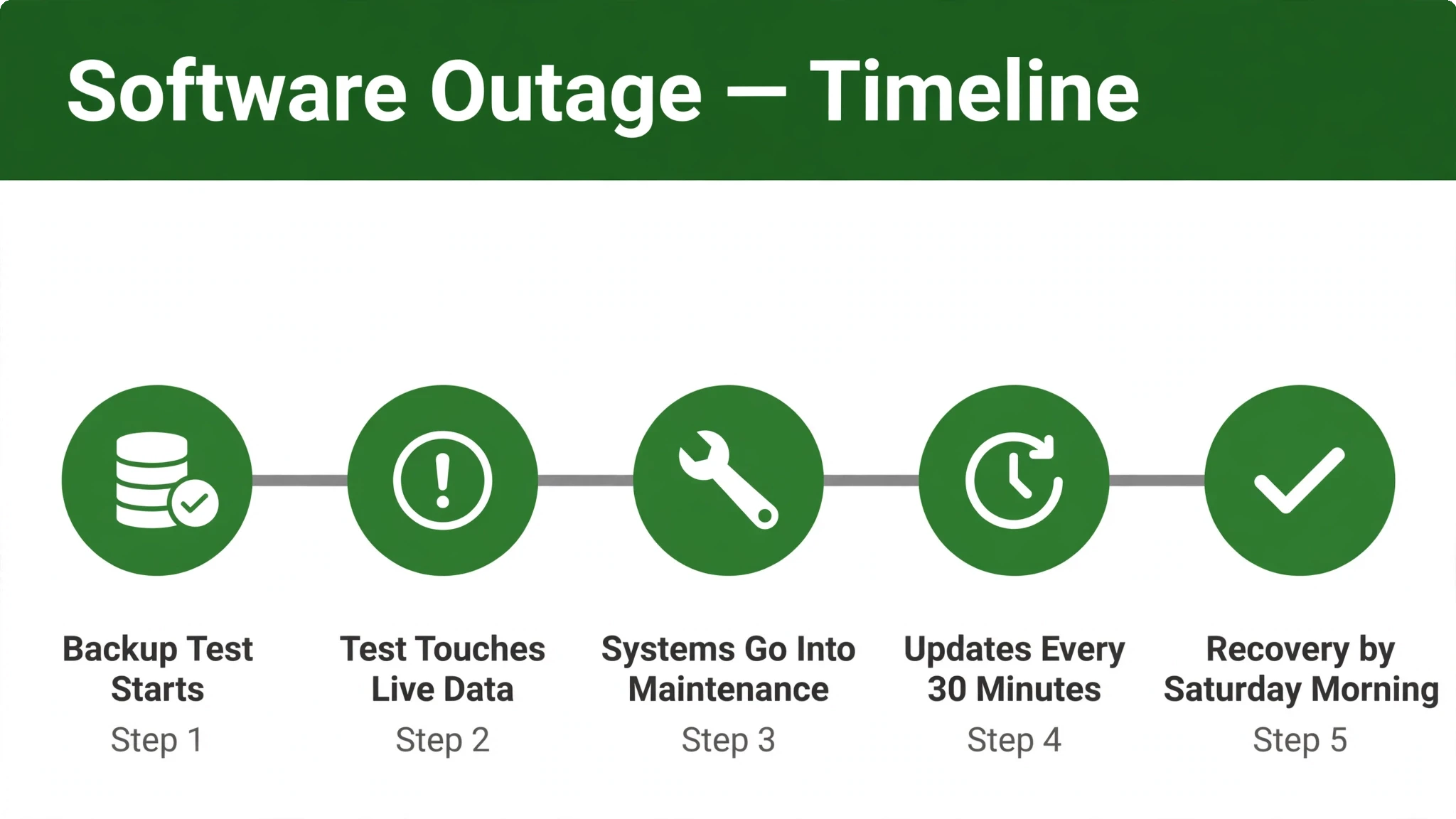
The Workday outage began on Friday evening, November 13, 2026, while the company was validating a weekly maintenance window for its disaster-recovery tenants. According to the notice Workday shared with customers, services inside the disaster-recovery site unexpectedly connected to the production databases during that validation. The result was data left in an inconsistent state, which Workday said could cause errors when people tried to access their accounts, or cause jobs, integrations and tasks to fail with missing transaction errors. Workday placed its WD1 production tenants into maintenance and promised updates every 30 minutes while it worked on a fix.
The human impact arrived quickly. Staff at affected organisations found themselves locked out of the system that records their working hours, their pay, their time off and their benefits. Emerson College in Boston told its community that Workday had taken the system offline at about 22:15 GMT on Friday for unplanned maintenance, and extended its open enrolment deadline to 17:00 GMT on Monday, November 16, so nobody would lose their benefits choices to the Workday outage. Washington University reported that Workday was still performing data validation activities into Saturday. Florida Atlantic University shared Workday’s customer message with its own IT community as the recovery progressed.
By Saturday morning, the picture was improving but not finished. In a customer message posted by Florida Atlantic University’s IT team at 12:45 GMT on Saturday, Workday said reindexing and tenant release was expected to complete for the majority of customers by 11 a.m. Eastern time. Downdetector had recorded nearly 3,000 outage reports shortly after 5 p.m. on Friday, a sharp spike for a business software platform that most people only think about on payday. Workday said only that “some” customers were affected and never published a count. Its customer roster includes large retailers such as Target, Walmart and Nordstrom, but neither Workday nor the reporting named which companies were actually hit, and the customer list is not an affected list.
Two things the Workday outage was not matter as much as what it was. No source reported a cyberattack. The company’s own notice traced the failure to its own backup testing, and reporting from the San Francisco Chronicle, quoted across the coverage, confirmed the same account. A spokesperson told LiveNOW from FOX that some customers were experiencing a service disruption and the company was working urgently to investigate and resolve the issue. The story, in other words, was self-inflicted: a safety drill that touched the live system it was meant to protect.
It was also the second major software outage of the week, and it landed on the same day as the FAA nationwide ground stop, which had halted every departing flight in America that afternoon. The Microsoft Outlook outage two days earlier had already put downtime on everyone’s mind. By Friday night, millions of Americans had watched three different systems they depend on fail in three days, and the Workday outage was the one that touched their pay.
Why the Workday Outage Is a Marketing Story
It is easy to file a software outage under technology and move on. That misses where the damage actually lands. A company like Workday sells to chief financial officers, chief people officers and IT leaders, and its entire pitch is a promise: hand us the most sensitive operations in your company — who gets paid, how much, when, and what benefits they hold — and we will run them without drama. The product is reliability, packaged as software. When the platform goes down on a Friday evening, the marketing promise is the thing that breaks, in front of the buyers who signed the contracts.
The stakes are visible in the numbers. Workday reported subscription revenue of 2,471 million dollars in the three months to July 31, 2026, which works out to roughly 27 million dollars a day. That is the scale of the trust involved: thousands of organisations paying millions a day for a system they cannot do without. Research on technology downtime puts the average cost of IT downtime at 5,600 dollars a minute, according to Gartner figures cited in status-page guides. For the companies locked out of Workday, the cost was not only the minutes. It was payroll runs delayed, enrolment windows missed, and HR teams fielding questions they could not answer.
The Workday outage is also a marketing story because of who was watching. The people who could not log in were employees, and employees talk. They posted on social media, they messaged colleagues, and they searched for answers. Every one of those searches was a moment when Workday’s brand was being judged by people who never chose the software but live with it every day. Business software has two audiences: the buyer who signs and the user who suffers. An outage speaks to the second audience first, and the second audience is the one that tells the buyer what to do next time.
That is the thread running through the seven lessons of the Workday outage below. They are not about servers or databases. They are about how a business sells trust, what happens when the trust is tested in public, and what any small business can copy — both as a seller of its own reliability and as a buyer choosing which software to trust.
Lesson 1: The Backup Test Is a Brand Moment
The first lesson of the Workday outage is the strangest one, and it starts with the cause. The failure did not come from neglect. It came from diligence. Workday was testing its disaster-recovery environment — the backup systems that exist so the company can keep running when something goes wrong. During that test, the disaster-recovery services connected to the live production databases instead of staying separate, and the data they touched was left inconsistent. The safety drill became the incident.
There is a hard truth inside that irony for every business that sells reliability. The things you do to prove you are reliable are themselves moments when reliability is on display. A backup test, a security audit, a system migration, a new release — each one is a promise being tested in front of your customers, and each one can become the story if it goes wrong. Workday’s own quarterly filing had anticipated exactly this kind of event, warning that its cloud applications could be significantly interrupted while procedures to restore services were carried out. The company knew the risk existed. Knowing it did not prevent it.
The marketing lesson is not to stop testing. It is to treat every test like a public event, because that is what it becomes when it fails. That means testing in ways that cannot touch live customer data, rehearsing the communication alongside the technical steps, and having the first customer message written before the test begins rather than after it fails. For a small software company, the practical version is simple: never run a test against production data, always have a named person ready to post the first update, and assume the worst case will be the one your customers remember.
For businesses that buy software rather than build it, the lesson points the other way. When a vendor tells you about its disaster-recovery testing, ask what separates the test from your live data. The answer matters more than the uptime percentage on the sales page, because the Workday outage shows that the gap between a test environment and a production database can be exactly one mistake wide. In the Workday outage, the test did not fail quietly. It failed in a way that locked thousands of people out of their pay, and the irony — the backup test breaking the thing it protected — is the detail everyone will remember. That is what a brand moment looks like when it goes wrong.
Lesson 2: Your Status Page Is Your Most Honest Marketing Page
The second lesson of the Workday outage is about the page most companies treat as an afterthought. When software goes down, the first place customers look is the status page, the public dashboard that says whether the service is working and what is being done about it. Workday’s status page requires a customer login, which meant that during the Workday outage, reporters covering the story could not read it, and the public could not check it. The company’s own account of the failure reached the outside world second-hand, through notices shared by universities and through journalists quoting the San Francisco Chronicle.
That is a marketing failure, not a technical one. A status page is the one page a buyer reads when trust is on the line, and buyers read it before they buy as well as during an incident. Research from a G2 buyer survey, cited in status-page guides, found that 89 percent of software buyers check a vendor’s status page before purchasing. A public page with live component health, a steady rhythm of updates and an honest incident history tells a buyer more about a company than any sales deck. A page hidden behind a login tells them something too: that transparency stops where the marketing starts.
The numbers behind status pages are striking. PagerDuty’s research, cited in the same guides, found that a well-run status page reduces support ticket volume by up to 40 percent during incidents, because customers who can see what is happening stop asking. Forrester research found that companies which communicate proactively during incidents see 60 percent lower churn than those that stay silent. And research from Everbridge found that 56 percent of stakeholders were more frustrated by poor communication than by the incident itself, while 87 percent expected regular updates until the problem was resolved. The pattern is consistent: people can tolerate a service being down. They struggle to tolerate being kept in the dark about it.
For a small business, the lesson scales down cleanly. If you sell software, publish a public status page before you need one, show live health for each part of your service, and keep at least 90 days of incident history visible, including the bad days. A page that shows 99.95 percent uptime with documented incidents and honest resolutions is more believable than a page that claims 100 percent forever. If you sell a service rather than software, the equivalent is a single public place where customers can check what is happening when something goes wrong — a page on your website, a pinned post, a voicemail message — updated on a rhythm your customers can rely on. In the Workday outage, the absence of a readable public status page meant the story was told by other people, in other words, on other channels. Your status page is your most honest marketing page. Make sure the public can actually read it.
Lesson 3: “Some Customers” Is a Sentence That Fills Itself
The third lesson of the Workday outage is about a two-word phrase. Workday said “some” customers were affected. It never said how many, and it never named any of them. That is a reasonable instinct — a company in the middle of an incident does not have a final count, and naming customers without their consent would be worse. But the Workday outage shows what happens to a vague number in a vacuum: other people fill it in.
Within hours of the Workday outage, reports were circulating that named large employers as affected, including Walmart, Target, Netflix and others. The careful reporting noted the distinction — these are Workday customers, not confirmed affected companies — but the distinction did not travel as fast as the names. One roundup put it plainly: Workday had only said “some” customers were affected and had not given a count, and no report named which ones. Yet the names were already in the headlines, attached to a story the companies involved had not confirmed. Vagueness does not stay vague. It becomes speculation, and speculation becomes the story.
There is a better way to handle the same uncertainty, and it costs nothing. Say what you know in concrete terms, even when the terms are small: how many reports you have received, which service is affected, what customers should do, and when the next update will arrive. Say what you do not know, and say when you will know it. “We have confirmed the issue affects customers on our WD1 production tenants, we are validating the full scope now, and the next update is in 30 minutes” gives people something solid to hold. “Some customers are affected” gives them a blank space, and blank spaces get filled by whoever shouts first.
For a small business, this lesson applies every time something goes wrong and you do not yet have the full picture. Resist the urge to shrink the problem into a vague phrase. A restaurant that says “some orders are delayed” invites every customer to assume theirs is the one. A shop that says “deliveries in the north of the city are running two hours late, the next update is at 4 p.m.” gives its customers a fact they can use. In the Workday outage, the company that runs payroll for more than 11,500 organisations could not say how many of them were affected, and within a day the internet had answered the question for it — with names. Precision, even about a small number, beats vagueness every time.
Lesson 4: A 30-Minute Rhythm Beats a Perfect Message
The fourth lesson of the Workday outage is about cadence, and it is the one Workday got most visibly right. When the company placed its production tenants into maintenance, it promised updates every 30 minutes. That promise showed up in the customer notices shared by universities, and it shaped how the recovery was covered: each new message carried a timestamp, a status and a next step, and the rhythm itself became evidence that someone was in control.
The rhythm matters more than the wording. Incident-response guidance from PagerDuty recommends a first customer-facing update within 10 to 15 minutes of confirming an impact, then a predictable rhythm of roughly every 30 minutes during a major outage, even when there is nothing new to report. The reason is psychological as much as practical. Silence during an outage is read in one of two ways: either the company does not know something is broken, or it knows and is not saying. Neither reading is kind. A short update on a steady rhythm — “still working on it, next update in 30 minutes” — reads as control, even when the news is bad. Google’s own incident guidance makes the same point: unless you acknowledge that an incident is happening and that it is being addressed, people assume nothing is being done.
The Workday outage also shows why the rhythm has to survive the recovery, not just the crisis. The messages that mattered most on Saturday morning were not dramatic. They were administrative: reindexing was under way, tenant release was expected to complete for the majority of customers by 11 a.m. Eastern, times would vary by tenant. That is unglamorous language, and it is exactly what an HR manager waiting to run payroll needed to hear. A recovery communicated in steady, boring updates is a recovery people can plan around. A recovery announced once, in a single triumphant message, leaves everyone guessing until it arrives.
For a small business, the practical version is a rule you can write on a card: first message within 15 minutes, then an update every 30 minutes until it is fixed, even if the update only says you are still working on it. Decide the rhythm before anything breaks, and put the person who owns it in writing. In the Workday outage, the 30-minute promise was the most reassuring thing the company said all weekend, because it was a promise about behaviour rather than about outcomes. Anyone can promise a fix. A rhythm is a promise you can keep while the fix is still uncertain, and customers notice the difference.
Lesson 5: Payroll Downtime Hits Differently — Know Your Stakes
The fifth lesson of the Workday outage is about stakes, and it is the one that separates a payroll platform from almost any other kind of software. When an email service goes down, people cannot send messages. When a payroll system goes down, people cannot be sure they will be paid, cannot clock in for a shift, and cannot finish the benefits enrolment that decides their health cover for the next year. The Workday outage hit all three at once, during open enrolment season, on a Friday evening when the next working day was already a weekend.
That difference changes what good communication looks like. A generic status update — “we are investigating a service disruption” — is adequate for a tool people can live without for a day. It is not adequate for a system that touches pay. The customers who needed the most from Workday during the Workday outage were not IT administrators. They were HR teams explaining to employees why they could not check their pay, and employees wondering whether the money would arrive. The useful messages were the specific ones: which functions were down, what the workaround was, and what would happen to the enrolment deadlines that fell inside the Workday outage window. Emerson College extending open enrolment to Monday, November 16, was that kind of message — a concrete answer to a concrete fear.
The broader principle is one every business should steal from the Workday outage: know what your product means in your customer’s life, and communicate at that level. A booking system that goes down on a Saturday night is not a technical incident; it is a restaurant full of people with nowhere to sit. A delivery platform that fails on a holiday weekend is not a bug; it is a family without dinner. The companies that communicate well during an outage are the ones that describe the impact in the customer’s terms, not in their own. Workday’s own notice did this in part, listing the functions affected — access to tenants, jobs, integrations, tasks — but the language was written for administrators. The employees locked out of their pay needed the same information in words about their lives.
For a small business, the exercise is worth doing before anything breaks. Write down the three worst things that happen to your customers when your service stops, in their words rather than yours. Then write the message you would send for each one. In the Workday outage, the stakes were pay, hours and health cover — the three things no employee can shrug off. A business that knows its stakes communicates like it understands them, and customers can tell the difference between a company that knows what it broke and a company that only knows which server failed.
Lesson 6: The Post-Mortem Is Content Marketing
The sixth lesson of the Workday outage looks past the weekend, to the document that has not been published yet. As of the first reports, Workday had not published a full root-cause report, and the company’s first explanation was still the one carried in its customer notices and in the San Francisco Chronicle’s reporting. That gap is normal — a proper investigation takes time — but it is also an opportunity, because in software, the post-mortem is one of the most trusted pieces of content a company can publish.
A good post-mortem does three things that no sales page can do. It explains what happened in plain language, including the part the company got wrong. It explains what will change so it does not happen again, with dates rather than intentions. And it proves, by existing, that the company would rather be honest than look perfect. Buyers read post-mortems during vendor selection. Engineers share them. Journalists quote them. A post-mortem that says “our disaster-recovery test connected to production because the separation between the two environments depended on a step we did not verify, and here is the check we have added” is more persuasive than a hundred uptime claims, because it shows a company that found the real cause instead of the convenient one.
The Workday outage is a strong candidate for exactly that kind of document, because the cause is specific and the fix is structural. The failure was not a mystery. A test environment touched production data, and the separation between them failed. A post-mortem that names the mechanism, the verification that was missing, and the change that now prevents it would do more for Workday’s reputation than any apology, because it would give every buyer a concrete reason to believe the same failure cannot repeat. Silence after the recovery, by contrast, leaves the story where the headlines left it: a backup test broke payroll.
For a small business, the lesson is to write the post-mortem even when nobody asks for it, and to publish it where your customers can find it. When your service fails, the follow-up message — what happened, what changed, what you will do differently — is the content that turns a bad day into a reason to trust you more. Most businesses skip this step because it feels like admitting fault. The Workday outage shows the opposite: the fault is already public, and the only question is whether the explanation comes from you or from everyone else. A business that explains its own failure owns the story. A business that stays quiet rents it out.
Lesson 7: Vet Your Vendors Like a Marketer
The seventh lesson of the Workday outage is for the buyers, and it is the one most small businesses need most. If you run a small business, your software stack is your reputation. When your payroll provider goes down, your employees blame you. When your booking system fails, your customers blame you. When your email platform stops, your clients blame you. The vendor caused the failure, but you own the experience, and the Workday outage is a reminder to choose vendors the way a marketer would: by reading their behaviour during a bad day, not their promises on a good one.
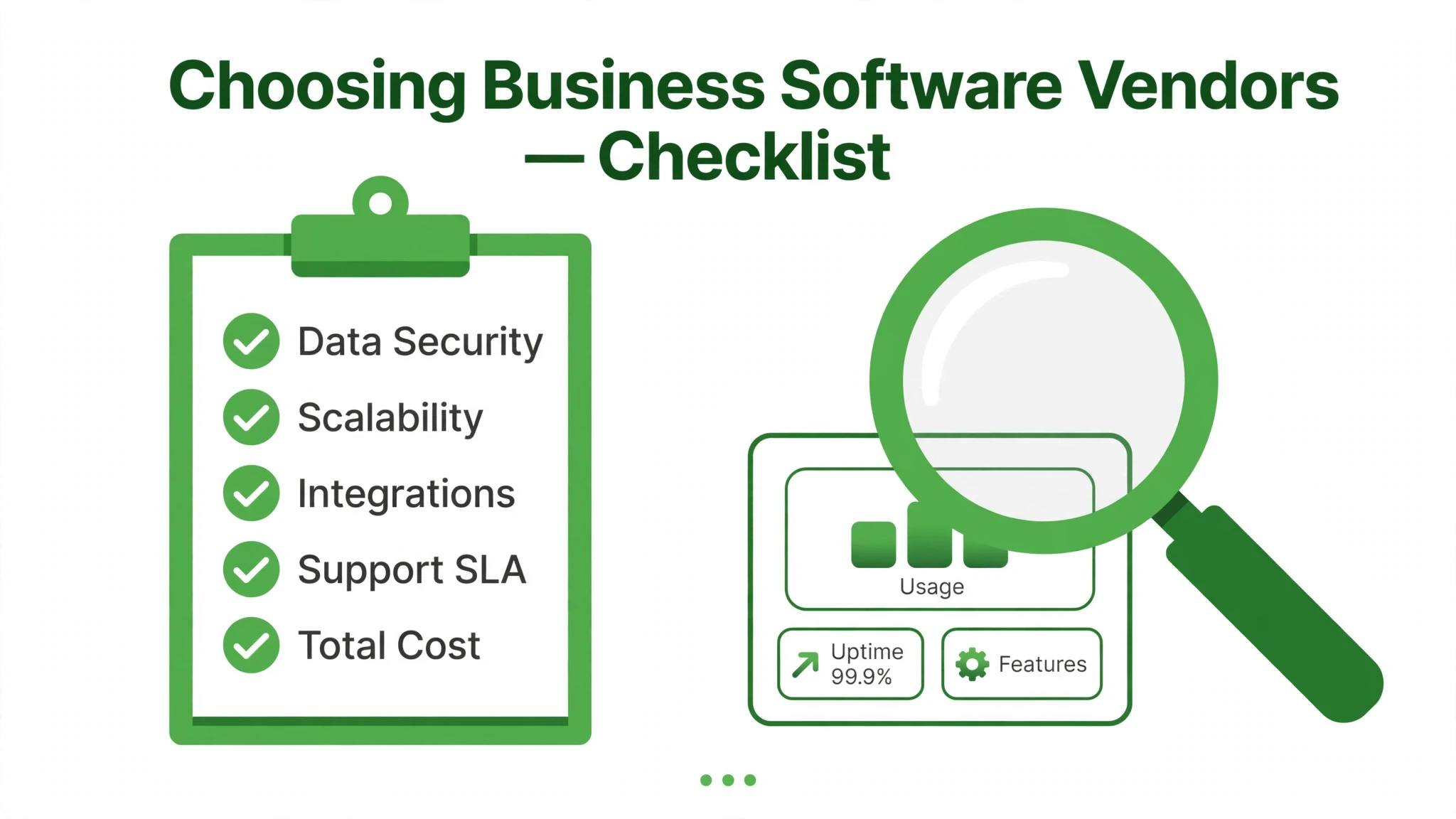
There is a checklist for that, and the Workday outage supplies most of it. First, find the vendor’s status page before you buy, and check whether it is public. If it requires a login, you will be blind during the next outage, exactly as the public was during this one. Second, read the incident history. A vendor that shows 90 days of uptime with documented incidents, honest resolutions and published post-mortems is more trustworthy than one that shows a perfect record with nothing behind it. Third, ask about the update rhythm: how fast is the first message, and how often do updates arrive during a major incident? Fourth, ask what separates their test environments from your live data, because the Workday outage began in exactly that gap. Fifth, ask for the service-level commitment in writing, and check whether the numbers are measured publicly or only claimed.
The Workday outage also reframes what reliability marketing should sound like. Vendors love to advertise uptime percentages — 99.9 percent, 99.99 percent, five nines — but a percentage is a claim about the past, and the Workday outage shows how quickly a claim becomes a question. The stronger signal is behaviour: a public status page, a fast first update, a steady rhythm, a named cause, a published post-mortem. Those are the things a buyer can verify before signing, and they are the things that matter when the software stops. One status-page guide puts the rule bluntly: a single misleading green light destroys more confidence than a dozen candid incident reports.
For a small business choosing software this week, the Workday outage is a free case study in what to look for. Open the vendor’s status page. Read the last three incidents. Check whether the updates arrived on a rhythm and whether the post-mortems named a real cause. If the page is hidden, the history is empty, or the percentages have no evidence behind them, that is your answer — and it costs nothing to find out before you sign. In the Workday outage, the companies that had chosen their vendor carefully still went down. The ones that had chosen on behaviour rather than on brochures at least knew what to expect, and when to expect the next update.
What Small Businesses Can Copy This Week
You do not need a payroll platform or a disaster-recovery environment to use the lessons of the Workday outage. You need a plan, written now, while nothing is wrong. Here is the version a small business can build in a single afternoon.
First, publish your own status page, even a simple one. A page on your website that says whether your service is running, updated on a rhythm your customers can rely on, is worth more than any uptime claim. If you sell software, use a dedicated status-page service and make it public. If you sell a service, keep a single page or pinned post where customers can check what is happening when something goes wrong.
Second, write your fifteen-minute message in advance. Draft three short templates: one for a service outage, one for a delay or closure, and one for a problem caused by someone else, like a supplier or a platform. Each template should say what happened in one sentence, what customers should do next, and when the next update will arrive. Keep them in a shared document every team member can reach, and name the person who posts them.
Third, set your rhythm and keep it. First message within fifteen minutes, then an update every thirty minutes until the problem is fixed, even if the update only says you are still working on it. The Workday outage shows that a rhythm is a promise you can keep while the fix is still uncertain, and customers notice the difference between a company with a rhythm and a company that posts once and disappears.
Fourth, vet your vendors this week, while the Workday outage is fresh. Open the status page of every tool your business depends on. Check whether it is public, read the last three incidents, and ask whether the vendor separates its test environments from your live data. If a vendor hides its status page behind a login, ask why — and weigh the answer before you renew.
Fifth, write the post-mortem habit into your business. Decide now that after any disruption, you will message affected customers personally, explain what happened in their terms, and say what changed. The follow-up is where a small business beats a large one, because a personal message from a real person is something a payroll platform cannot send to eleven thousand organisations.
What Not to Do When Your Software Goes Down
The lessons of the Workday outage above describe what works. The Workday outage also shows what to avoid. Do not hide your status page behind a login. The one page your customers need most during an incident is the one they must be able to read without an account, and a hidden page means your story gets told by other people. Do not shrink the problem into a vague phrase. “Some customers are affected” invites speculation, and speculation fills itself with names you did not choose. Do not post once and go quiet. Quiet during the Workday outage leaves customers choosing between two unkind conclusions: the team has no idea, or it knows and is staying silent. Do not sell during the Workday outage. A promotional post scheduled to go out while your customers cannot check their pay reads as indifference, and it will be screenshotted. Pause scheduled posts the moment a serious disruption begins. And do not skip the post-mortem. The failure is already public. The only question is whether the explanation comes from you or from everyone else.
Conclusion
The Workday outage of November 13, 2026, began with a backup test and ended with thousands of people unable to check their pay. It lasted into Saturday morning, drew nearly 3,000 outage reports in its first hour, and became one of the most searched terms in America — on the same day the country’s flights were grounded and two days after its email went down. The cause was not an attack. It was a drill that touched the live system it was meant to protect, and the irony is the detail everyone will remember.
Those are the seven lessons of the Workday outage, and they belong to every business, not just software companies. The backup test is a brand moment. Your status page is your most honest marketing page. “Some customers” is a sentence that fills itself. A thirty-minute rhythm beats a perfect message. Payroll downtime hits differently, so know your stakes. The post-mortem is content marketing. And vet your vendors like a marketer, because your software stack is your reputation.
Your business will have its own bad day. It will not arrive with a nationwide alert, and it will not trend on Google. But your customers will still be watching, and they will still judge you on the same seven things. The brands that prepare for that day now — with a public status page, a fifteen-minute message, a thirty-minute rhythm, and a plan for the follow-up, the same playbook the Workday outage teaches — are the ones that turn a failure into the reason customers trust them more, not less.
If your business needs help building that kind of trust — from social media marketing that responds in real time, to SEO and video marketing that keep your brand visible when it matters most — KKeyQik helps small businesses across the United States turn attention into customers. Get in touch and let us build a communication plan that is ready before your next bad day arrives.
Frequently Asked Questions
The Workday outage was a service disruption on Friday, November 13, 2026, that left staff at affected organisations unable to log in to Workday, the cloud platform used for payroll, timekeeping, benefits and human resources. Employees could not clock in or out, check their pay, request time off or finish benefits enrolment while the system was in maintenance mode. Workday said only that "some" customers were affected and never published a count, though the platform serves more than 11,500 organisations worldwide.
The outage began during a test of Workday's disaster-recovery systems. While validating a weekly maintenance window for its disaster-recovery tenants, services in the disaster-recovery environment unexpectedly connected to the live production databases, leaving data in an inconsistent state. Workday placed its WD1 production tenants into maintenance while it worked on a fix. The company described the cause in a customer notice, and reporting from the San Francisco Chronicle confirmed the same account.
The outage began on Friday evening, November 13, 2026, and recovery was still under way on Saturday morning. In a customer message shared by Florida Atlantic University's IT team at 12:45 GMT on Saturday, Workday said reindexing and tenant release was expected to complete for the majority of customers by 11 a.m. Eastern time. Some organisations, such as Emerson College, extended open enrolment deadlines to Monday, November 16, so nobody would lose benefits choices to the disruption.
No source reported a cyberattack. Workday's own notice traced the failure to its backup testing, and a company spokesperson told LiveNOW from FOX that some customers were experiencing a service disruption while the company worked urgently to resolve it. The outage was self-inflicted: a safety drill that touched the live system it was meant to protect. Workday had not published a full root-cause report when the first coverage was filed.
Workday is used by more than 11,500 organisations worldwide, according to the San Francisco Chronicle's reporting on the outage. Its customer roster includes large retailers such as Target, Walmart and Nordstrom, though neither Workday nor the reporting named which companies were actually affected by the outage. The company reported subscription revenue of 2,471 million dollars in the three months to July 31, 2026, which works out to roughly 27 million dollars a day.
A status page is a public dashboard that shows whether a service is working, what is affected, and what is being done about it. It matters because it is the first place customers look when something breaks, and buyers check it before purchasing too: a G2 buyer survey cited in status-page guides found that 89 percent of software buyers check a vendor's status page before buying. Workday's status page requires a customer login, which meant reporters and the public could not read it during the outage, and the company's account of the failure reached the outside world second-hand.
Incident-response guidance from PagerDuty recommends a first customer-facing update within 10 to 15 minutes of confirming an impact, then a predictable rhythm of roughly every 30 minutes during a major outage, even when there is nothing new to report. Workday promised updates every 30 minutes when it placed its production tenants into maintenance, and that rhythm became the most reassuring thing the company said all weekend. A short update on a steady schedule reads as control, even when the news is bad, while silence is read as either ignorance or concealment.
Check whether the vendor's status page is public and readable without a login, read the last three incidents in its history, and look for published post-mortems that name a real cause. Ask how fast the first update arrives during an incident and how often updates follow. Ask what separates the vendor's test environments from your live data, because the Workday outage began in exactly that gap. Finally, ask for the service-level commitment in writing and check whether the numbers are measured publicly or only claimed.
A post-mortem is a written account of what went wrong, published after an incident is resolved. A good one explains what happened in plain language, including the part the company got wrong, and explains what will change so it does not happen again, with dates rather than intentions. Buyers read post-mortems during vendor selection, engineers share them, and journalists quote them. A post-mortem that names the real cause is more persuasive than any uptime claim, because it shows a company that found the actual problem instead of the convenient one.
Post a short message on the channel your customers actually check within fifteen minutes, saying what happened in one sentence, what customers should do next, and when the next update will come. Then update every thirty minutes until the problem is fixed, even if the update only says you are still working on it. Describe the impact in your customers' terms rather than in technical language, update every channel with the same message at the same time, and follow up personally once the problem is fixed with an explanation of what changed.