

Introduction
October Prime Day 2026 is live right now. At this very moment, Amazon’s fall deal event — officially called Prime Big Deal Days — is running its 48-hour sprint across Amazon US, UK, Canada, and other marketplaces, from October 6 through October 7. Shoppers are hunting deals in real time, carts are filling, and somewhere in your category, a competitor’s Sponsored Products ad is sitting in the top-of-search slot that could have been yours.
That urgency is exactly why “when is prime day” is one of the fastest-rising searches in the United States tonight. But this post is not a shopping guide. It is written for the other side of the checkout button: the brands, sellers, and marketing teams who treat October Prime Day 2026 as what it really is — one of the highest-converting 48-hour windows in American e-commerce, and a live-fire rehearsal for Black Friday and the holiday quarter.
Consider the scale. Adobe Analytics found that the July 2025 Prime Day event — extended to four days for the first time — generated $24.1 billion in total US online spending, up 30.3% year over year, roughly equal to two Black Fridays packed into a single event. Mobile drove the majority of it, paid search drove more than a quarter of the sales, and AI-assisted shopping traffic surged 3,300% year over year.
October Prime Day 2026 is smaller than the summer one, but it plays the same role: a concentrated burst of purchase intent from the most deal-primed audience on the internet, arriving six weeks before Black Friday — close enough to test everything, far enough to fix what breaks.
This post breaks down nine practical Amazon marketing plays drawn from how winning brands handle October Prime Day 2026: how they budget for the CPC surge instead of fearing it, how they pace spend across the 48 hours, how they layer ad types, how they optimize listings for AI shopping assistants like Rufus, and how they turn two days of chaos into a retargeting asset that pays out for weeks. Every play works right now, during the live event — and every one of them ports directly to your Black Friday plan. If you would rather have a team running this playbook for you while you watch the dashboard, KKeyQik’s PPC specialists manage Amazon and Google ad campaigns built for moments exactly like this.
The Facts: What October Prime Day 2026 Actually Is
Before the plays, the verified facts — because October Prime Day 2026 only teaches when the details are right:
The event. October Prime Day 2026 — Amazon’s fall Prime event, Prime Big Deal Days — widely called “October Prime Day” — runs October 6–7, 2026: 48 hours of member-exclusive deals on Amazon US, UK, Canada, Italy, and other marketplaces. It is the second of Amazon’s two annual Prime Day events.
The summer edition. Amazon’s summer Prime Day 2026 ran June 23–26 — notably earlier than the usual mid-July slot. The fall event held its traditional early-October position, opening in the early hours of Tuesday, October 6.
The pattern. Amazon has run two Prime Days a year since 2022: a summer event (July 11–12 in 2023, July 16–17 in 2024, July 8–11 in 2025) and a fall event (October 10–11 in 2023, October 8–9 in 2024, October 7–8 in 2025). The 2025 summer event was the first stretched to four days, and Adobe Analytics confirmed it as the biggest Prime Day ever at $24.1 billion in US online spend.
The audience. Prime Day deals are exclusive to Prime members — a self-selected audience of the internet’s most committed online shoppers. Adobe found that nearly two-thirds of Prime households placed two or more orders during the 2025 summer event, and mobile accounted for 53.2% of transactions, or $12.8 billion. This is not casual browsing traffic. It is a deal-primed, card-in-hand crowd.
Why marketers care. Paid search accounted for 28.5% of Prime Day 2025 sales, up 5.6% year over year, per Adobe. Influencers drove 19.9% of sales and converted at ten times the rate of regular social traffic. And generative AI tools — chatbots, shopping assistants like Amazon’s Rufus — drove a 3,300% year-over-year surge in retail site visits. Every one of those channels is a lever a brand can pull during October Prime Day 2026, starting today.
That is the factual foundation. Now the nine plays.
Play 1: Budget for the Surge, Not the Baseline
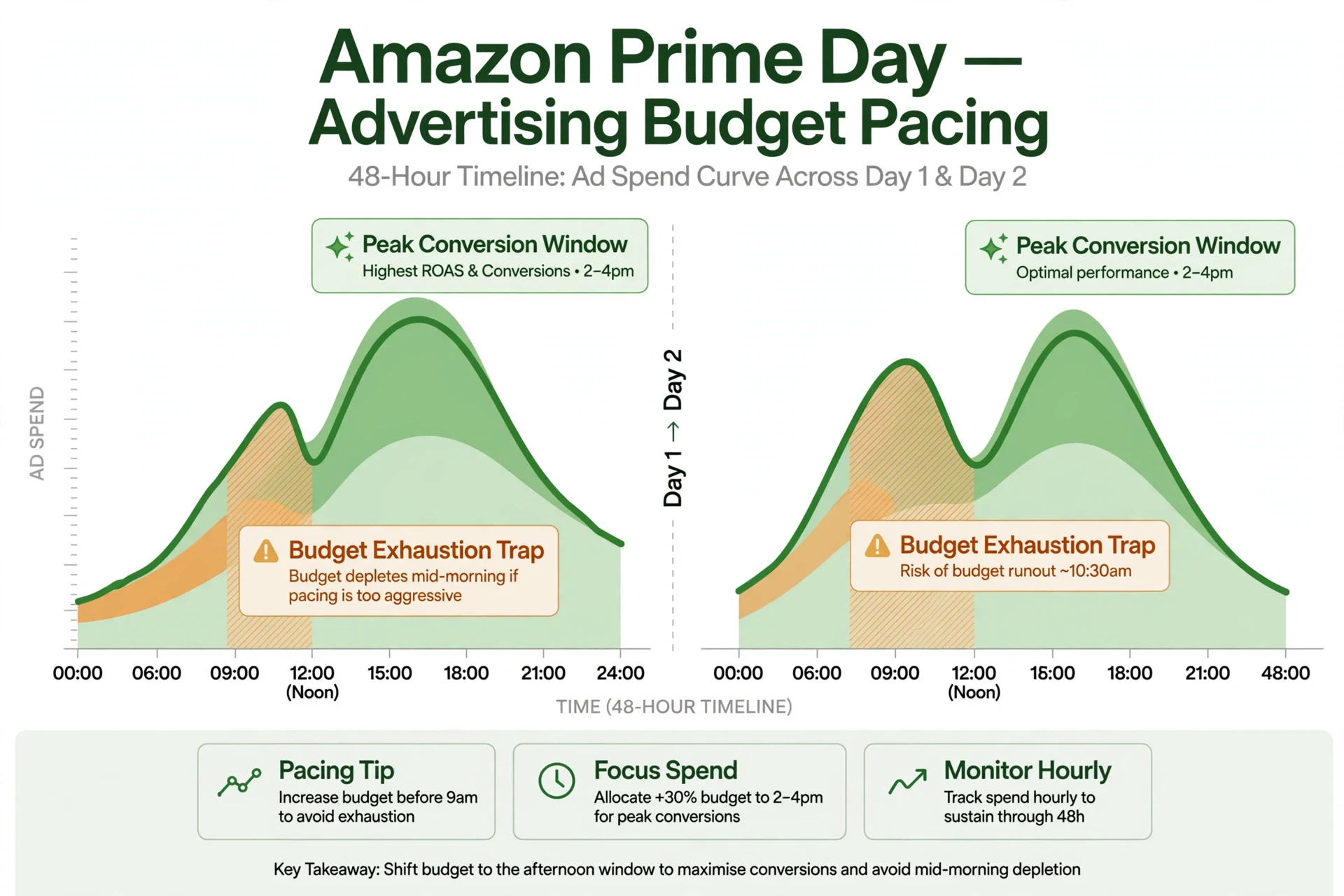
The single most common way brands lose October Prime Day 2026 happens before the event even starts: they set ad budgets for a normal Tuesday. Then the most purchase-ready traffic of the quarter arrives, their campaigns hit daily caps by mid-morning, ads go dark during peak conversion hours — and the day’s biggest opportunity quietly belongs to whoever budgeted like it mattered.
The numbers explain why this keeps happening. Analyses of Prime Day advertising consistently show cost-per-click surging during October Prime Day 2026 — one 2026 planning guide puts the spike at 60–80% above normal, with top-keyword CPCs reaching $2.50 to $8.00 in competitive categories, while another dataset pegs the typical Prime Day CPC lift at 20–40%. Either way, the direction is the same and the cause is obvious: every serious seller in your category is bidding for the same finite top-of-search slots at the same time. During October Prime Day 2026, auction pressure is the price of admission.
The standard planning benchmark from agencies that live through this twice a year: prepare for a 300–500% increase in daily ad spend versus normal operations, and raise daily budgets to 2–3x normal for the event window. That sounds reckless until you see the other side of the ledger — conversion rates during Prime Day typically run 400–800% above baseline, which is why the math usually holds. The brands that get hurt are not the ones spending aggressively; they are the ones whose campaigns exhaust their budgets by 11 AM on Day 1 and sit silent while the afternoon wave — often the highest-converting stretch — rolls through without them.
Amazon’s own seller guidance says it plainly: during peak events your ads receive more clicks than normal, you run out of budget faster, and when that happens your ads pause until midnight. The fix is budget rules scheduled in advance — automatic budget increases during the event window — plus inventory checks so a stockout does not strand your spend. Set the rules before the event, not during it.
Your move: Right now, during October Prime Day 2026, check pacing hourly. If a campaign blows through its daily cap in the first three hours, add budget immediately — do not wait for tomorrow. For Black Friday, schedule budget rules now: 2–3x daily budgets for deal ASINs, with hourly pacing checks on day one.
Play 2: Let the Conversion Math Justify the Click Cost
Play 1 tells you to spend more. Play 2 tells you why that is rational — and how to keep it rational, because “spend more” without a governor is just a faster way to lose money.
The CPC spike during October Prime Day 2026 is real, but CPC is only half of the profitability equation. The other half is conversion rate, and during deal events it moves much harder than click costs do. When conversion rates run several multiples above baseline during October Prime Day 2026 while CPCs rise by a fraction of that, the effective cost per acquisition can actually improve during the event — even as every individual click gets more expensive. Feedvisor’s analysis of the 2024 event found Sponsored Ads delivering a 187% lift in impressions and a 141% lift in ad sales while ROAS held stable. That is the surge working as intended: more expensive clicks, far more converting clicks, same or better return.
The practical discipline is to manage this at the level of budgets and placement, not raw bids. The instinct during October Prime Day 2026 is to jack up bids dramatically; the better move, per the data, is to give campaigns budget headroom and let Amazon’s auction dynamics work, while pushing top-of-search placement multipliers on your proven winners. Keep dynamic bidding on “up and down” so the algorithm can raise bids in real time for auctions it judges likely to convert — Amazon expands the maximum upward adjustment during Prime Day specifically to help sellers compete for prominent placements — and lower them when the signals are weak.
Then watch the only two numbers that matter intraday: spend pacing and conversion rate by campaign. If a campaign’s conversion rate is running 5x baseline and it is pacing to exhaust budget by noon, that is not a problem — that is the event working, and the answer is more budget, not less.
If a campaign’s CPC has doubled but its conversion rate has barely moved, that is the signal to pull placement multipliers back, tighten targeting, or shift budget to the winners. The surge rewards the attentive and punishes the set-and-forget.
Your move: Build a one-page intraday scorecard for the event: budget pacing vs. plan, CPC vs. baseline, conversion rate vs. baseline, by campaign. Review it every two hours during October Prime Day 2026. Winners get more budget the same day; laggards get their multipliers trimmed before they burn the afternoon.
Play 3: Run the Three-Phase Calendar — Especially the Third Phase
Most brands treat October Prime Day 2026 as a two-day event. The brands that extract the most value from it treat it as a five-week campaign with three phases — and the phase most sellers skip is the one with the best returns.
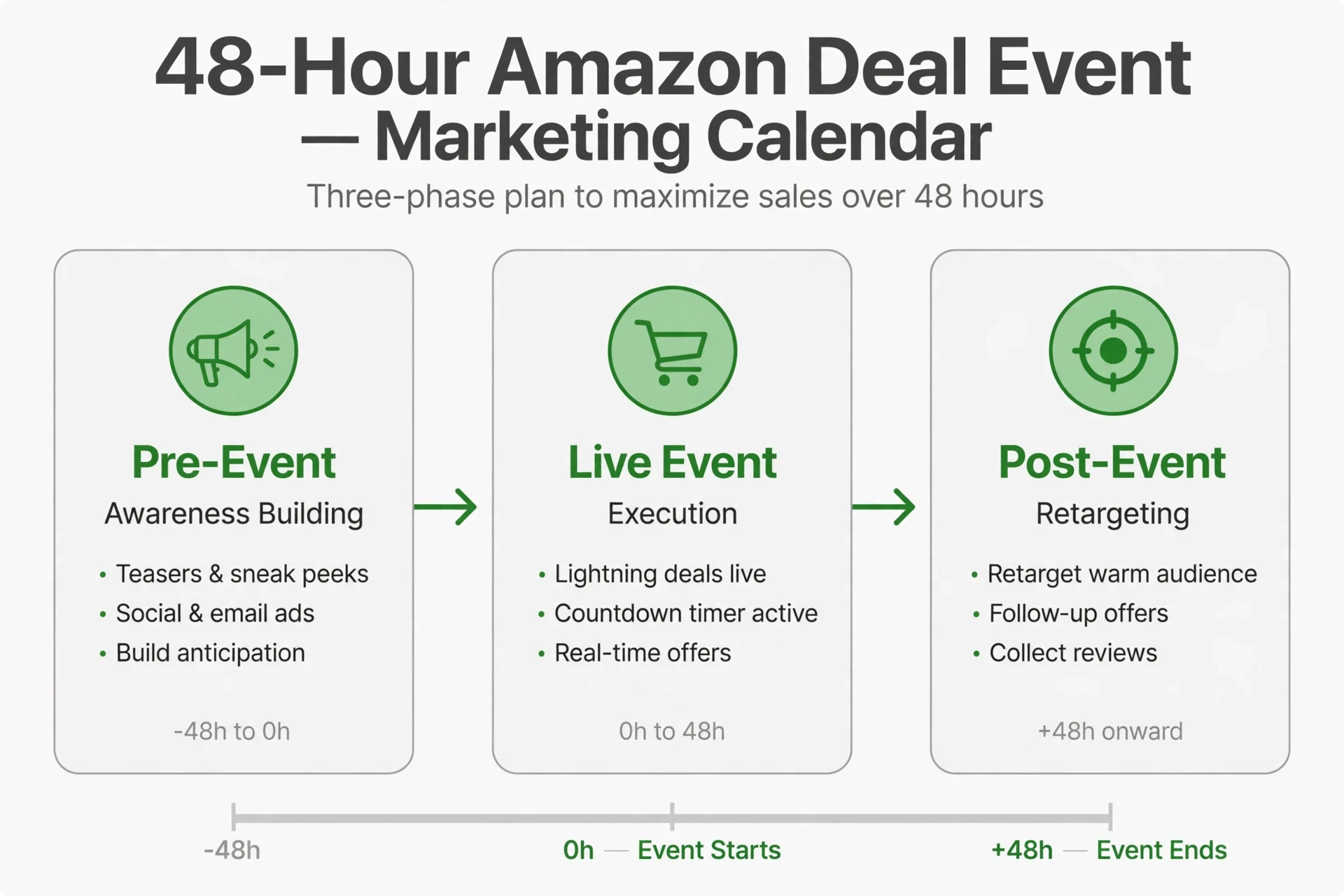
Phase one: pre-event awareness (2–4 weeks out). This is audience-building, not direct response. Run Sponsored Brands and Amazon DSP to put your products in front of shoppers before they have their wallets out. Amazon’s own data shows that brands layering DSP with Sponsored Ads saw 2.6x higher purchase rates and 3.6x sales lifts compared to Sponsored Ads alone, per Feedvisor’s analysis. That layering effect is the foundation the event itself stands on: shoppers who have seen your brand twice before Prime Day convert at meaningfully higher rates when they see it a third time during the event. For October Prime Day 2026, this phase is already behind you — note what you wish you had built, because Black Friday’s pre-event window opens within days of Prime Day ending.
Phase two: the event (Oct 6–7). This is Plays 1 and 2 in action: 2–3x budgets, hourly pacing, placement aggression on proven ASINs, inventory monitored so ads never drive traffic to an out-of-stock listing. Keep creative and deals consistent — mid-event creative swaps reset learning and waste the highest-intent hours.
Phase three: post-event retargeting (1–2 weeks after). This is the abandoned goldmine. Shoppers who browsed during October Prime Day 2026 but did not buy are the highest-intent audience you will own all quarter — they looked at your product, during a deal event, and hesitated. Follow them with Sponsored Display and DSP retargeting at around 1.5x normal budgets for at least a week after the event. Feedvisor’s data consistently shows the post-event window delivering better ROAS than the event itself, because you are targeting proven intent without the event’s CPC inflation. Then normalize: lower bids and placement modifiers within 24–48 hours after the window closes so post-event settings do not quietly bleed margin.
The compounding logic is what matters for your holiday plan. October Prime Day 2026’s retargeting audiences become Black Friday’s warmest prospect pool. Every phase feeds the next.
Your move: Before October Prime Day 2026 ends on October 7, build your post-event retargeting audiences from this week’s browsers and cart-abandoners. Keep them live at 1.5x budgets through mid-October, then roll the winners straight into your Black Friday audience plan.
Play 4: Defend Your Branded Search Like It Is Prime Real Estate
During October Prime Day 2026, your brand name becomes a battleground. Competitors know that shoppers searching for your brand are the highest-intent buyers in your category, and deal events are when conquesting — bidding on rivals’ brand terms — spikes hardest. If you are not defending your own branded queries with exact-match Sponsored Products and Sponsored Brands placements, someone else’s deal will be sitting above your organic listing at the exact moment your customer is ready to buy.
This is not paranoia; it is auction mechanics. Branded keywords are typically a brand’s cheapest converting traffic under normal conditions, which is precisely why competitors target them when traffic peaks — the intent is worth the premium. During October Prime Day 2026, an undefended brand term means a shopper who typed your name sees a competitor’s discounted alternative first, in a side-by-side comparison, at the moment of maximum deal sensitivity. That is a sale you manufactured for someone else.
The defense is cheap and simple: exact-match campaigns on your brand terms and key product names, with top-of-search placement multipliers high enough to hold the top slot, running before and during the event. Protect common misspellings and your flagship product names too — October Prime Day 2026 shoppers are often mobile (remember: 53.2% of Prime Day 2025 transactions were mobile), typing fast, and autocorrect is not your friend. Branded defense is also where Sponsored Brands video earns its keep: a 30-second brand story above the search results does more than hold the slot — it frames the comparison before the competitor’s listing even loads.
The same logic applies in reverse, carefully. Conquesting competitors’ terms during October Prime Day 2026 can work, but only with genuinely competitive offers and honest comparison creative — and only where your listing can win the side-by-side on reviews, price, and Prime delivery. Bid on a rival’s name with a weaker offer and you have just paid premium CPCs to advertise their superiority.
Your move: Audit your branded search coverage today: every brand term, flagship product name, and common misspelling, exact match, defended at top of search. Then check who is bidding on your terms right now — during October Prime Day 2026, that intelligence is worth more than any report.
Play 5: Optimize Listings for Rufus — the AI Shopper Is Already Here
The most underpriced discovery channel of October Prime Day 2026 does not cost anything per click, because it is not an ad product at all. It is Rufus, Amazon’s AI shopping assistant — and the broader wave of AI-assisted shopping that Adobe measured at a 3,300% year-over-year traffic surge during the 2025 summer event. Shoppers are increasingly asking an AI what to buy instead of scrolling search results, and the listings that surface in those answers are winning sales without paying for the click.
Sellers who have optimized for Rufus are already reporting the payoff: meaningful improvements in best-seller-rank positioning and declines in TACoS (total advertising cost of sale) — a natural result when product discovery starts flowing through AI answers that carry zero media cost. The mechanism is straightforward. Rufus answers shopper questions by synthesizing listing content — titles, bullet points, product descriptions, reviews, and A+ Content — so listings written as thin keyword strings underperform while listings written as genuine answers overperform. The AI cannot recommend what it cannot understand.
Rufus optimization for October Prime Day 2026 looks like this: titles that state what the product is and who it is for in plain language, not keyword-stuffed fragments; bullet points that answer the five questions shoppers actually ask (will it fit, is it compatible, how long does it last, what is in the box, how is it different); A+ Content modules that explain use cases visually, since Rufus draws on enhanced content; and a review base that mentions real-world usage, because review text feeds the AI’s understanding of the product.
None of this is exotic SEO — it is the same clarity and completeness that converts human shoppers, now doing double duty for the AI ones.
The strategic point is bigger than October Prime Day 2026. Every Prime Day accelerates the shift: Adobe’s data shows generative AI still trails email and paid search in absolute share, but its growth curve is nearly vertical. Listings you rewrite for Rufus during October Prime Day 2026 keep compounding through Black Friday, the holidays, and every deal event after. This is the rare optimization with zero media cost and a lengthening shelf life.
Your move: Pick your top five deal ASINs and rewrite one bullet point each as a direct answer to a real shopper question — the kind of question someone would ask a store clerk. That single pass is the highest-ROI copy work you can do during the live event. If your team needs a systematic pass across the catalog, SEO for product and category pages is core to how KKeyQik approaches search visibility — and the same principles now apply to AI discovery.
Play 6: Win the Mobile Majority With Creative That Converts at a Glance
Here is a number that should reshape your October Prime Day 2026 creative priorities: 53.2% of Prime Day 2025 transactions happened on mobile, contributing $12.8 billion in online spending, per Adobe. The majority of your event traffic is shopping on a phone screen, in stolen moments, scrolling fast — and your creative has about two seconds to earn the tap.
Mobile-first creative for October Prime Day 2026 means designing for the smallest screen first. Hero images must communicate the product and the deal at thumbnail size: the product large and unmistakable, the discount or Prime badge legible without zooming, backgrounds clean enough that the product pops against a feed of competing deals. Lifestyle images still matter, but during October Prime Day 2026 the hierarchy flips — clarity beats atmosphere, because the shopper is comparing six thumbnails side by side and the blurriest value proposition loses.
Below the hero image, the conversion stack does the quiet work. Structured bullet points that lead with the benefit, not the feature. A+ Content that answers objections visually — comparison charts against the older model, size guides, “what’s in the box” modules — because mobile shoppers will not scroll through a wall of text to resolve a doubt; they will bounce to the next listing. Published analyses of Amazon creative consistently find that high-resolution imagery, structured bullets, and enhanced brand content lift purchase likelihood by 5–10%, and during a deal event that compounds: every point of conversion rate is worth more when traffic is 5x normal.
Then there is the deal presentation itself. Prime-exclusive discounts, coupons, and Lightning Deals are not just pricing tactics — they are creative elements. The strikethrough price, the coupon badge, the “limited time” framing: these are the visual cues that convert deal-primed intent into action. Stack them coherently — a coupon on top of a Prime-exclusive discount reads as genuine value; a confusing pile of overlapping promotions reads as a trick. And keep the math honest: nothing damages a listing faster during October Prime Day 2026 than shoppers discovering the “deal” price matches last month’s regular price.
Your move: Open your top ten deal listings on your phone right now — not desktop, phone. If the value proposition is not instantly clear at thumbnail size, fix the hero image today; it is the cheapest conversion-rate lever available during the live event. For the creative system behind it — the imagery, video, and testing cadence — KKeyQik’s creative testing discipline for paid campaigns applies the same rigor to every ad format.
Play 7: Ride the Influencer Wave Instead of Watching It
Adobe’s Prime Day 2025 data contains a channel insight too many Amazon sellers ignore: influencers drove 19.9% of Prime Day sales, up 15% year over year, and converted at ten times the rate of general social traffic. Nearly a fifth of a $24.1 billion event flowed through creators. During October Prime Day 2026, the influencer economy is not a side channel — it is a primary demand engine, and brands that treat Amazon as a closed ecosystem are leaving it untapped.
The mechanism is simple and well-matched to the event. Prime Day concentrates purchase intent; creators concentrate trust. A creator’s “my October Prime Day 2026 picks” roundup, unboxing, or 60-second demo does what your listing cannot: it puts a human face on the buying decision at the exact moment millions of people have decided to buy something. The 10x conversion multiple over regular social is the tell — this is not awareness traffic. It is bottom-of-funnel traffic with a trusted guide.
The practical playbook for October Prime Day 2026: seed products to creators in your niche two to three weeks before the event (for Black Friday, that outreach starts the week Prime Day ends); give them genuine deal hooks — early access to the discount, exclusive coupon codes they can offer followers, bundles assembled for their audience; and make the Amazon attribution clean with trackable links so you can see which creators actually move units. Amazon’s own creator and influencer programs give you native rails for this, but the strategy works identically with off-Amazon creators driving external traffic to your listings — and external traffic, as a bonus, tends to convert well and diversify you away from pure on-Amazon auction dependence.
One caution for the live event: do not chase mega-influencers at mega-prices during the 48 hours. The efficient move right now is activating the mid-tier and micro-creators already posting Prime Day content in your category — they are cheaper, their audiences are more niche-aligned, and their content is already in the deal-discovery feeds. Save the big creator partnerships for the planned Black Friday push, where lead time lets you negotiate properly.
Your move: Search your category’s October Prime Day 2026 content on TikTok, Instagram, and YouTube today. Identify five creators already posting deal roundups, and offer them your live discount plus a follower-exclusive coupon code. Then systematize it: a consistent social presence turns one-off creator spikes into durable demand, which is what makes the next deal event cheaper to win.
Play 8: Treat Deals as Marketing, Not Margin Surrender
Every October Prime Day 2026 conversation eventually reaches the uncomfortable question: do we actually have to discount? The honest answer is that you do not strictly have to — but you should understand exactly what you are buying when you do, and what you are forfeiting when you do not.
Deals during October Prime Day 2026 are a customer-acquisition cost wearing a pricing costume. A Prime-exclusive discount or coupon does three jobs at once: it wins the buy box battle on value perception, it earns the deal badges that dominate mobile search results, and it feeds the velocity signals — sales rank momentum — that lift organic positioning long after the event ends. Sellers consistently report that the rank lift from a strong Prime Day persists for weeks, which means the discount is partly an investment in Q4 organic visibility. Evaluated against the cost of buying that same visibility through ads in November, the deal often wins.
The discipline is in the structure. Run the numbers on tariff-squeezed margins before the event, not during it: know your floor price, your break-even after Amazon fees and ad spend, and the discount depth at which the event stops being marketing and starts being charity. Then choose the deal mechanic that fits the math — Prime-exclusive discounts for straightforward price cuts, coupons for a softer touch that preserves the list price anchor, Lightning Deals for time-boxed urgency on hero ASINs. Layer them deliberately rather than stacking everything on every product; not every ASIN needs to be a doorbuster, and your margin will thank you for the restraint.
Two operational notes for the live event. First, watch inventory like a hawk — Amazon’s own Prime Day guidance puts inventory preparation alongside budget preparation for a reason, because ads driving traffic to an out-of-stock listing burn money twice (the click cost plus the lost rank velocity). Second, keep repricing dynamic but bounded: automated repricing protects you against competitors undercutting your deal mid-event, but set floors so an algorithmic race to the bottom does not erase the margin you modeled.
Your move: For every deal ASIN, write down three numbers before October Prime Day 2026 ends: the discount depth, the break-even ROAS at that depth, and the inventory coverage in days. Any ASIN missing one of the three gets its deal pulled or its ad budget capped — no exceptions, even mid-event.
Play 9: Measure What Matters — Then Reset Before the Next Wave
The final play of October Prime Day 2026 happens after the buy buttons cool: measuring the event correctly, and resetting your account before the settings that won Prime Day start losing you money in the quiet weeks after.
Start with the metric stack. ROAS on ad spend is the headline, but it is not the story. TACoS — total advertising cost of sale, ad spend divided by total revenue including organic — tells you whether the event actually grew the business or just rented sales you would have gotten anyway. New-to-brand metrics tell you whether you acquired customers or merely harvested existing demand; Prime Day’s value as a customer-acquisition event is arguably its biggest strategic prize, since a new customer acquired in October buys again in November and December. And halo sales — the lift in non-advertised ASINs and the organic rank improvement in the weeks after — are where the deal-as-marketing thesis from Play 8 gets proven or refuted.
Then the reset, which matters more than most sellers realize. The bid increases, placement multipliers, and budget rules that were correct for October Prime Day 2026 become margin leaks the moment the event ends. Published Amazon advertising guidance is explicit: normalize post-event settings — lower bids and reduce placement modifiers within 24 to 48 hours after peak retail dates — to prevent post-holiday margin loss. Put it on the calendar now, as a task with an owner, because the quiet Monday after a big event is exactly when nobody feels like touching the account.
Finally, run the retrospective while the data is fresh. Which campaigns justified their 2–3x budgets, and which just spent them? Which ASINs converted the AI-driven discovery traffic, and which need the Rufus rewrite from Play 5? What did your competitors do on your branded terms, and what does that tell you about their Black Friday plan? October Prime Day 2026 is six weeks before Black Friday — the single most valuable property of this event is that it is a full-scale rehearsal with real money attached. Teams that debrief it properly walk into the holidays with a tested playbook; teams that do not walk in with hope.
Your move: Schedule two calendar blocks right now: one for October 8 to normalize bids and budgets, and one for October 9 to debrief the event with the full metric stack — ROAS, TACoS, new-to-brand, and halo. If you want that debrief to turn into a Black Friday plan with teeth, KKeyQik’s reporting discipline keeps every campaign accountable to the numbers that matter.
Conclusion: The 48-Hour Window Is Open — Act Like It
October Prime Day 2026 is not a spectator event for brands. It is 48 hours of the most concentrated purchase intent in e-commerce, running right now, October 6–7 — and it is also the last full-scale rehearsal before the holiday quarter decides your year.
The nine plays compress to a simple operating posture: budget for the surge instead of fearing it, let conversion math govern the CPC spike, run all three phases with special attention to post-event retargeting, defend your branded search, write listings the AI shoppers can understand, design creative for the phone in everyone’s hand, ride the creator wave, treat deals as acquisition investment with modeled floors, and measure the full stack before resetting for the next wave. None of these require a bigger team. All of them require deciding, before the event ends, that October Prime Day 2026 was a campaign — not a weekend that happened to you.
Six weeks from now, Black Friday will reward whoever learned the most from these 48 hours. Start the debrief on October 8. And if you want a team that has run this playbook across categories and quarters — the budgeting, the pacing, the creative testing, the measurement — talk to KKeyQik about managing your Amazon and Google advertising through the holiday season.
When the surge comes from bad news instead of deals — a product recall, a safety scare — the same branded-search discipline becomes a crisis playbook: see our recall SEO playbook for the seven-step crisis version.
Related reading: Amazon’s $2.5B Refund Wave: 7 Ecommerce Marketing Lessons for Sellers in 2026
Want to put this to work for your business? KKeyQik plans and delivers Google Ads and Meta Ads campaigns for small businesses, with an in-house team available 24/7. See our ads management service or get a quote within 24 hours.
Frequently Asked Questions
October Prime Day 2026 — officially called Prime Big Deal Days — runs October 6–7, 2026, a 48-hour event on Amazon US, UK, Canada, and other marketplaces. It is Amazon's fall Prime event, separate from the summer Prime Day, which ran June 23–26, 2026. Deals are exclusive to Prime members.
They are the same concept in two seasonal editions. "Prime Day" is the summer event (usually June or July), while "Prime Big Deal Days" is the fall edition held each October — widely nicknamed "October Prime Day." Both are 48-hour Prime-member-exclusive deal events, and brands should plan advertising for each with the same three-phase approach: pre-event awareness, live-event execution, and post-event retargeting.
Plan for daily budgets at 2–3x normal levels during the event, and be ready for total daily ad spend to run several multiples above baseline. The reason is auction pressure: click costs surge during the event, but conversion rates typically surge far harder, so well-managed campaigns hold their return. The real danger is not overspending — it is hitting your daily cap by mid-morning and going dark during peak conversion hours.
Because every serious seller in a category bids for the same finite top-of-search placements at the same time. Industry analyses peg the Prime Day CPC lift anywhere from 20–40% to 60–80% above normal depending on category. The spike is rational auction mechanics, not a malfunction — and since conversion rates rise even faster during the event, the effective cost per acquisition often stays flat or improves for disciplined advertisers.
It is the pattern where campaigns burn through their full daily budget in the first hours of the event and then sit silent — ads paused until midnight — during the afternoon and evening, which are often the highest-converting stretches. Agency data from past events shows uneven day-to-day performance, so the fix is hourly pacing checks: if a converting campaign is pacing to exhaust budget early, add budget the same day rather than waiting.
Write listings as answers, not keyword strings. Rufus, Amazon's AI shopping assistant, recommends products by synthesizing titles, bullet points, descriptions, reviews, and A+ Content — so titles should state plainly what the product is and who it is for, bullets should answer real shopper questions (fit, compatibility, contents, differentiation), and enhanced content should explain use cases visually. Sellers optimizing for Rufus report better rank momentum and lower total ad cost of sale, since AI-driven discovery costs nothing per click.
Use all three, in sequence. In the weeks before the event, Sponsored Brands and Amazon DSP build the awareness layer — Amazon data shows layering DSP with Sponsored Ads multiplies purchase rates. During the event, Sponsored Products with top-of-search placement focus captures the purchase intent. After the event, Sponsored Display and DSP retarget the browsers who did not buy — consistently the highest-ROAS phase because it targets proven intent without event-level click inflation.
Keep retargeting budgets at around 1.5x normal for at least one to two weeks after the event, targeting shoppers who browsed or abandoned carts during Prime Day. This audience is the warmest prospect pool you will own all quarter, and it becomes the seed audience for Black Friday campaigns. Just remember to normalize bids and placement modifiers back down within a day or two after the window closes so event-level settings do not bleed margin.
You can compete without deep discounts, but understand the trade-off. Deals earn the badges that dominate mobile search results and drive the sales velocity that lifts organic rank for weeks — a discount is partly an investment in Q4 visibility. If you hold price, compensate with stronger levers: defended branded search, superior creative and A+ Content, Rufus-optimized listings, and creator-driven external traffic. Whatever you choose, model the math first: know your floor price and break-even ROAS before the event, not during it.
Look at four metrics together: ROAS on ad spend, TACoS (ad spend divided by total revenue, which reveals whether you grew the business or just rented sales), new-to-brand customer rate (Prime Day's biggest strategic prize — an October customer buys again in November and December), and halo sales (the lift in non-advertised products and organic rank in the weeks after). Then debrief while the data is fresh — October Prime Day is the last full-scale rehearsal before Black Friday, and the teams that study it properly walk into the holidays with a tested playbook.